Nepal Trekking Difficulty Levels Explained: Which Trek Actually Matches Your Fitness
Here is the sentence that surprises more first-time trekkers than any other: in Nepal, “moderate” means six to eight hours of walking a day, at altitude, for a week or more. If your reference point is a national park trail rated “moderate” back home — three hours, gentle grade, café at the trailhead — Nepal trekking difficulty levels are calibrated on a different scale entirely, and picking a route off someone’s Instagram is how people end up in a helicopter.
This guide ground-truths the standard grading system, tells you what actually makes a Himalayan trek hard (spoiler: it’s rarely just the altitude), and maps every major route we’ve covered onto an honest four-tier scale. At the end there’s a short self-assessment so you can pick the trek that matches your actual fitness — not your ego. Bookmark this page; it’s the front door to every trek guide on this site.
How Trek Grading in Nepal Works (and Why It Confuses Everyone)
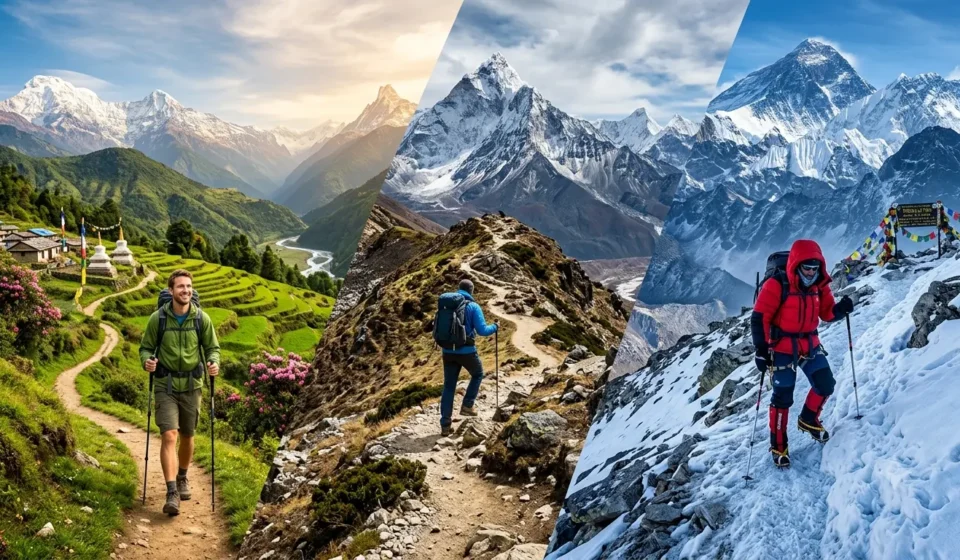
Most Nepali operators grade treks on four tiers: easy, moderate, strenuous, and very strenuous (sometimes “challenging” or “expedition-grade”). Broadly: easy treks stay below ~3,000 m with 4–6 hour days and need no acclimatisation; moderate treks push toward 4,000+ m with 6-hour days; strenuous treks reach 5,000–5,500 m with 6–7 hour days and mandatory acclimatisation; and very strenuous treks add 8+ hour days, remote terrain, and high passes.
The system is sound. The problem is application. There is no central authority enforcing it, so a company selling Everest Base Camp treks has every incentive to call EBC “moderate” — and many do. Meanwhile the same word covers Poon Hill’s stone staircases and the approach to Tilicho Lake, which are not the same sport.
The second problem is that grades compress five separate variables into one word. What actually determines how hard your trek feels:
- Maximum sleeping altitude. Not the highest point you touch — the height you sleep at. Sleeping above 4,000 m is a physiological event regardless of fitness. This is the variable that puts people in danger, and it’s why our altitude sickness guide is required reading above tier one.
- Daily hours and total days. Six hours a day for four days is a holiday. Six hours a day for fourteen days is an endurance event. Fatigue compounds.
- Ascent and descent per day. Nepal’s trails were built by people carrying loads between villages, not by trail engineers with switchback budgets. “Nepali flat” — down 400 m, up 500 m — is a running joke because it’s true.
- Remoteness. On the Annapurna routes, a twisted ankle means a jeep. In Dolpo, it means days from help. Remoteness multiplies the consequence of everything else.
- Season. The same trek is one grade harder in winter snow or monsoon mud. Check our best time to trek guide before assuming autumn conditions.
Hold those five in your head and the tiers below will make sense — and you’ll be able to grade any trek an agency pitches you, no matter what label they’ve put on it.
Tier 1 — Easy to Easy-Moderate: The Easiest Treks in Nepal
Sleeping altitude below ~3,600 m · 4–6 hour days · 4–6 days total · acclimatisation helpful but not structural
| Trek | Max altitude | Days | The honest one-liner |
|---|---|---|---|
| Poon Hill | 3,210 m | 4–5 | Nepal’s best reward-per-effort ratio — but respect the Ulleri stairs |
| Mardi Himal | ~4,200 m (viewpoint) | 4–6 | Ridge-walk gem; High Camp nights get properly cold |
| Ghandruk village loops | ~2,000 m | 2–4 | Teahouse life with Annapurna views, minimal suffering |
This is where you start if you’ve never trekked in the Himalaya, if you’re bringing kids, or if you have under a week. “Easy” still isn’t flat: Poon Hill’s Day 1 ends on 3,000+ stone steps, and plenty of gym-fit trekkers arrive at Ulleri humbled. But nights are warm-ish, villages are close together, escape routes are everywhere, and altitude is a non-issue with basic sense. Mardi Himal straddles the tier boundary — the days are short but High Camp (3,580 m) and the viewpoint push real altitude for a “short easy trek,” which is exactly the kind of fine print this page exists for.
You’re ready if: you can walk 4–5 hours with 500–600 m of climbing and feel tired, not destroyed.
Tier 2 — Moderate: The Honest Middle
Sleeping altitude 3,500–4,500 m · 5–7 hour days · 7–11 days · acclimatisation matters
| Trek | Max altitude | Days | The honest one-liner |
|---|---|---|---|
| Annapurna Base Camp | 4,130 m | 7–11 | Staircase endurance test into a mountain amphitheatre |
| Langtang Valley | 3,870 m (Kyanjin Ri 4,773 m optional) | 7–9 | Gentlest gradient into genuinely high terrain |
| Tilicho Lake | 4,919 m | 8–10 | Moderate days, serious altitude, one infamous landslide section |
This is where the Western-vs-Nepali grading gap bites hardest, so let’s be precise about what “moderate” buys you here: six-plus hours of daily walking, multiple consecutive days above 3,000 m, nights below freezing, and at least one or two days where the altitude makes an easy trail feel hard. None of these treks requires mountaineering skill or exceptional fitness. All of them require acclimatisation discipline and the humility to take rest days you paid for.
Tilicho deserves its own caveat: at 4,919 m it sleeps and climbs higher than anything else in this tier, and only its short daily distances keep it out of tier three. Treat it as the bridge trek — do it comfortably and you’re ready for what’s next.
You’re ready if: you can do back-to-back 6-hour hill days with 700–800 m of ascent, and you’ve read enough about AMS to name three symptoms without checking.
Tier 3 — Strenuous: The Big Classics
Sleeping altitude 4,400–5,000 m+ · 6–8 hour days · 10–16 days · acclimatisation is the itinerary
| Trek | Max altitude | Days | The honest one-liner |
|---|---|---|---|
| Everest Base Camp | 5,364 m (Kala Patthar 5,545 m) | 12–14 | Not technical — just high, cold, long, and unforgiving of shortcuts |
| Annapurna Circuit | 5,416 m (Thorong La) | 10–14 | Two weeks of variety with one enormous pass day |
| Manaslu Circuit | 5,106 m (Larke La) | 12–15 | The Circuit’s wilder sibling; Larke La is a genuine test |
| Gokyo Lakes | 5,357 m (Gokyo Ri) | 10–12 | EBC’s altitude without EBC’s traffic |
Everything in this tier crosses or sleeps above 5,000 m, which means multi-week commitment, pre-dawn pass starts, and days where wind chill is a planning factor. The defining days — Thorong La, Larke La, Kala Patthar — are 8–10 hours, started in the dark, at altitudes where your body operates on roughly two-thirds of sea-level oxygen. None of it is technical climbing. All of it punishes people who skipped training or compressed the acclimatisation schedule to save two days. That is the single most common way strong hikers fail these treks: fitness lets you outpace your acclimatisation, and the mountain calls that bluff around day eight.
You’re ready if: you’ve done a tier-two trek (or comparable multi-day hill trip), can sustain 7-hour days for two weeks, and your insurance covers helicopter evacuation above 5,000 m — not a joke, check the clause.
Tier 4 — Remote & Expedition-Grade: The Hardest Treks in Nepal
Variable altitude, extreme remoteness · 10–25 days · logistics, not just legs
| Trek | Max altitude | Days | The honest one-liner |
|---|---|---|---|
| Upper Mustang | ~4,200 m | 10–14 | Moderate legs, expedition logistics: restricted permits, wind, desert cold |
| Shey Phoksundo / Lower Dolpo | 3,611 m (lake; passes far higher beyond) | 9–18 | Nepal at its emptiest — help is days away, not hours |
| Upper Dolpo, Kanchenjunga (guides coming) | 5,100–5,350 m passes | 18–25 | Camping expeditions in all but name |
This tier breaks the neat fitness ladder, and that’s the point. Upper Mustang’s walking is honestly easier than EBC’s — the difficulty is that you’re in a restricted, arid, wind-scoured region where permits cost $50/day, infrastructure is thin, and self-sufficiency matters. Dolpo escalates that: past Phoksundo Lake you’re on camping routes over 5,000 m passes (Kang La, 5,350 m) where the grading systems stop being useful and expedition experience is the real entry requirement. Rate yourself here not by how far you can walk, but by how comfortable you are when the plan breaks.
You’re ready if: you’ve completed a tier-three trek, you’re comfortable with basic conditions for weeks, and “the jeep isn’t coming” sounds like an adventure rather than an emergency.
The Self-Assessment: Pick Your Tier in Two Minutes
Answer honestly — nobody’s watching. Score each question 0, 1, 2, or 3 as marked.
- Longest hike in the past six months? Under 3 hours (0) · 3–5 hours (1) · 6+ hours with real climbing (2) · multi-day hill trip (3)
- How do 500 m of continuous ascent (roughly 100 flights of stairs) feel? Unknown territory (0) · hard but done (1) · routine (2) · I’d add a weighted pack (3)
- Have you slept above 3,000 m? Never (0) · once, fine (1) · several times, fine (2) · above 4,500 m, fine (3)
- Weekly exercise? Rarely (0) · 1–2 sessions (1) · 3–4 with cardio (2) · 5+ including long efforts (3)
- If the day runs 3 hours over plan in bad weather, you feel: panic (0) · misery but coping (1) · grim humour (2) · this is why I came (3)
0–4 points: Tier 1. Take Poon Hill, love it, come back ambitious. 5–8: Tier 1–2 — Mardi Himal or Langtang, or ABC if you’ll train first. 9–12: Tier 2–3 — ABC comfortably; EBC or the Circuit with 8 weeks of preparation. 13–15: Tier 3 now, tier 4 when logistics appeal as much as landscapes.
Two overrides trump any score. First, question 3 is a hard gate: if you’ve never slept above 3,000 m, do a tier 1–2 trek before booking anything that sleeps above 4,500 m — no fitness score substitutes for knowing how your body handles altitude, because that response is largely independent of fitness. Second, money doesn’t move tiers: porters, better lodges, and pricier packages make any trek more comfortable, but nobody can carry altitude for you.
Moving Up a Tier
The good news: the ladder is climbable fast. Eight weeks of stair-focused training moves most people up one tier — the full programme is here. Trek order matters more than gym hours, though: Poon Hill → ABC → the Circuit is the classic three-trip progression, and each rung teaches the altitude lessons the next one examines. And whichever tier you pick, the guide requirement applies almost everywhere now, and costs scale with remoteness more than with difficulty.
FAQs
What are the difficulty levels of trekking in Nepal? Four tiers: easy (below ~3,000 m, 4–6 hour days), moderate (to ~4,500 m, 6-hour days), strenuous (5,000–5,500 m, 6–8 hour days, acclimatisation essential), and very strenuous/expedition-grade (high passes, 8+ hour days, remote terrain). Grades are set by operators, not a central authority — always check the underlying numbers.
What is the easiest trek in Nepal? Poon Hill (3,210 m, 4–5 days) is the standard answer and a fair one — big Annapurna–Dhaulagiri views, comfortable teahouses, no acclimatisation drama. Ghandruk-area village walks are gentler still.
What is the hardest trek in Nepal? Among teahouse treks, the Manaslu Circuit’s Larke La (5,106 m) is arguably the toughest single day. Beyond that, Upper Dolpo and Kanchenjunga are the hardest commonly attempted routes — remote camping expeditions with multiple 5,000 m+ passes.
Is Everest Base Camp harder than Annapurna Base Camp? Yes, clearly: EBC is roughly twice the distance, 1,200 m higher, and carries far greater altitude-sickness risk. ABC is stair-heavy but altitude-forgiving. Full comparison in our ABC guide.
Can a beginner trek in Nepal? Absolutely — on the right tier. Thousands of first-timers do Poon Hill, Mardi Himal, and Langtang every season. Start with our beginner’s guide and resist skipping tiers.
How fit do I need to be for Nepal trekking? For tier 1, ordinary walking fitness. For tier 3, you should sustain 6–7 hour hill days for two weeks. The self-assessment above gives you a two-minute answer; eight weeks of training moves you up a tier.
The Bottom Line
Nepal’s grading words are fine; the calibration is what catches people. Translate every label back to five numbers — sleeping altitude, daily hours, total days, daily ascent, distance from help — and you can’t be misled. Pick the tier your last six months of legs have earned, not the one your ambition wants, and remember the happiest trekkers on any trail are the ones who chose a route one notch below their maximum. The mountains reward margin.
Ready to choose? Start at your tier: Poon Hill · Annapurna Base Camp · Everest Base Camp · Upper Mustang. Still unsure? The 30 most-asked questions probably covers yours.
Grading reflects normal autumn/spring conditions as of July 2026. Winter and monsoon shift every trek up a tier.