Mardi Himal Trek: Nepal’s Best Short Trek for Beginners (2026/2027 Guide)
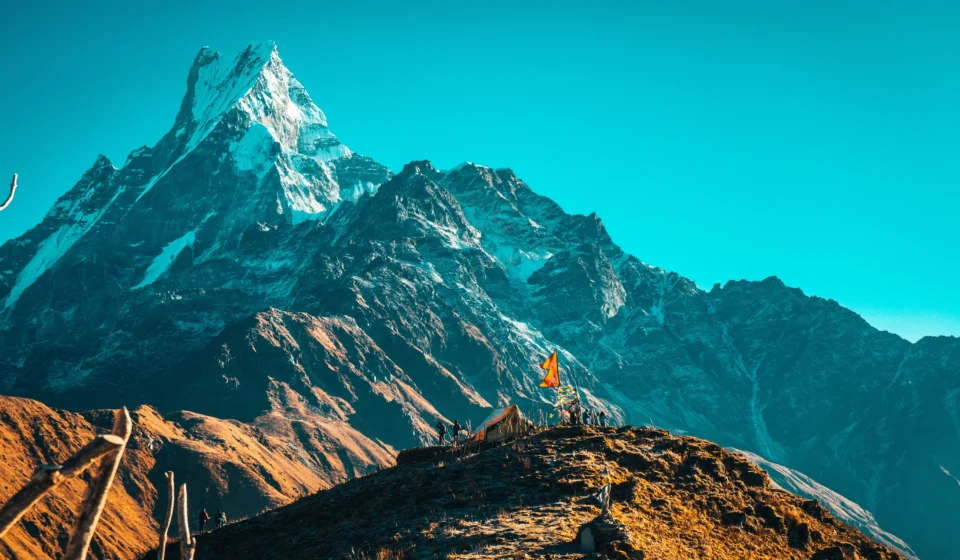
Machhapuchhre doesn’t look real from most angles — but from the Mardi Himal Trek’s Upper Viewpoint, at 4,200 m, you’re close enough that the Fishtail’s twin peaks fill the sky and Annapurna South stands right beside it, close enough to feel the scale rather than just see it. Five years ago almost nobody outside Nepal had heard of this trail. Now it’s one of the most-searched short treks in the Annapurna region — and for good reason: it delivers a genuine high-altitude viewpoint, off a quiet ridge trail, in less time and for less money than almost anything else in the Himalaya.
If you’ve already read our Poon Hill guide and are wondering whether Mardi Himal is the same trip with a different name — it isn’t. This guide covers what actually makes Mardi Himal different, a realistic 5-day itinerary, an honest cost breakdown, and the current 2026/2027 permit rules, so you can decide which of the two short treks is actually yours.
Mardi Himal at a Glance
| Fact | Detail |
|---|---|
| Highest point (standard itinerary) | Upper Viewpoint, 4,200 m |
| High Camp | 3,550 m |
| Duration | 5 days round trip from Pokhara (3–4 days possible, 6–7 with extra acclimatisation) |
| Distance | ~35–40 km round trip |
| Difficulty | Moderate — steeper and more exposed than Poon Hill |
| Permits | ACAP (NPR 3,000) + TIMS (status explained below) |
| Guide | Legally required since April 2023 |
| Realistic cost | ~$450–600 independent-style with a guide; $500–800 packaged |
| Best months | October–November, March–April |
| Start/end | Kande, ~45 minutes by jeep from Pokhara |
Mardi Himal vs. Poon Hill: Which One Is Yours?
Both are short, both are based out of Pokhara, both are genuinely achievable for first-time trekkers — which is exactly why people keep asking which one to pick. Here’s the honest comparison.
| Partuculars | Mardi Himal | Poon Hill |
|---|---|---|
| Max altitude | 4,200 m (Upper Viewpoint) | 3,210 m |
| Trekking days | 5 (3–4 fast, 6–7 relaxed) | 4–5 |
| Round-trip distance | ~35–40 km | ~57 km |
| Trail character | Forest into open ridge, narrow and exposed near the top | Forest and stone-staircase, wide and well-graded throughout |
| Crowds | Quiet — noticeably fewer trekkers, no big villages en route | Busy, especially Ghorepani in October |
| Infrastructure | Simple lodges from Low Camp up; fewer options, book ahead in peak season | Well-developed teahouses throughout, more choice |
| Altitude sickness risk | Low-moderate — you’re sleeping close to 3,550 m | Low — max altitude stays under 3,300 m |
| Views | Close-up Machhapuchhre and Annapurna South, single dramatic panorama | 360° panorama including Dhaulagiri, Annapurna I, and more peaks |
| Best for | Trekkers who want a quieter trail and a higher viewpoint, and don’t mind a steeper push | Trekkers who want the classic, most reliable short-trek experience with the least physical demand |
The honest self-selection test: choose Poon Hill if this is your very first multi-day trek, you want maximum mountain panorama for minimum physical demand, or you’re travelling with kids or older family members. Choose Mardi Himal if you’ve done a shorter hike before, want solitude over crowds, and don’t mind a narrower, steeper trail for a higher, more dramatic viewpoint. Neither requires the weeks of commitment of the Annapurna Circuit or Everest Base Camp — both are genuinely realistic on a one-week holiday, flights included.
The Route: Forest to Ridge
Mardi Himal starts at Kande (1,770 m), about 45 minutes by jeep from Pokhara — no long bus ride to a distant trailhead like Poon Hill’s Nayapul or ABC’s Ghandruk approach. From Kande, the trail climbs through rhododendron and oak forest to Forest Camp, then Low Camp (2,970 m), before breaking out of the tree line entirely above Badal Danda (“cloud hill” — accurately named). From there it’s a narrow, increasingly exposed ridge walk to High Camp (3,550 m) and on to the Upper Viewpoint at 4,200 m, with Machhapuchhre seemingly close enough to touch.
This is the trail’s defining feature relative to Poon Hill: you spend real time above the tree line on an open ridge, not just a single pre-dawn viewpoint hike. It’s also why the trail feels more remote — there are no villages between Kande and the descent, only trekking lodges built specifically to serve the route.
Day-by-Day Itinerary: The Classic 5-Day Route
Day 1 — Pokhara → Kande (drive) → Forest Camp (2,600 m). 45-minute jeep to Kande, then 4–5 hours climbing through rhododendron and oak forest. A steady, well-shaded ascent that eases you into the trek without Poon Hill’s brutal staircase equivalent.
Day 2 — Forest Camp → Low Camp (2,970 m). A shorter day, 3–4 hours, often via Rest Camp. This is a deliberately easy day built in for acclimatisation before the ridge opens up — don’t be tempted to push straight to High Camp even if you’re feeling strong.
Day 3 — Low Camp → High Camp (3,550 m). 3–4 hours, and the trail changes character here: forest gives way to rhododendron scrub and then open ridge above Badal Danda, with your first real views of Machhapuchhre and Mardi Himal itself. Afternoons often cloud in, so enjoy the morning visibility while it lasts.
Day 4 — High Camp → Upper Viewpoint (4,200 m) → descend to Low Camp or Siding. Up around 4:30 a.m. for a 2-hour climb along the exposed ridge to the Upper Viewpoint for sunrise on Machhapuchhre, Annapurna South, and Hiunchuli. Back to High Camp for breakfast, then a long descent — 6–7 hours — down toward Siding or back to Low Camp, depending on your onward transport. This is the big day; start early and dress for wind on the ridge.
Day 5 — Siding/Low Camp → Pokhara (drive). Finish the descent to a trailhead village (Siding or Lwang), where a jeep meets you for the drive back to Pokhara — you can be eating lakeside by early afternoon.
Faster or slower? A fit trekker who’s already acclimatised can compress this to 3–4 days by combining Days 1–2 or skipping Forest Camp. Less confident trekkers, or anyone wanting a genuine acclimatisation buffer, should add a night at Low Camp on the way up, turning it into 6–7 days — the same logic our beginner’s guide recommends for any route that puts you near 3,500 m+ overnight.
Mardi Himal Trek Cost 2026: The Honest Breakdown
A realistic independent-style trek (you + a hired guide) runs roughly $450–600 per person for 5 days. Fully packaged trips from a Pokhara/Kathmandu agency run $500–800, with mid-range operators clustering around $550–650.
| Item | Cost (USD) |
|---|---|
| ACAP permit | ~$22 (NPR 3,000) |
| TIMS card (see permits section) | ~$15 (NPR 2,000) |
| Licensed guide ($25–35/day × 5) | $125–175 |
| Pokhara–Kande jeep (return) | $15–25 |
| Rooms (NPR 500–800, higher near High Camp) | $20–35 |
| Food & drink ($20–30/day, rising with altitude) | $100–150 |
| Charging, Wi-Fi where available | $10–20 |
| Total | ~$460–600 |
Add a porter ($15–20/day) and you’re typically still under $700. As with every route in the Annapurna region, splitting guide and porter costs across a group of two to four trekkers is the single biggest way to bring the daily rate down. For a full regional cost comparison, see our Nepal Trekking Costs & Budget Guide.
What the numbers hide: cash only beyond Pokhara, fewer lodge options above Low Camp than on busier routes (rooms can sell out in peak season with no backup lodge next door), and thinner Wi-Fi/charging availability than Poon Hill or ABC. Budget a little extra patience, not just cash.
Permits Required for Mardi Himal in 2026
Two documents, and — as with most Annapurna-region treks right now — one of them is genuinely unsettled.
1. ACAP — Annapurna Conservation Area Permit. Mandatory. NPR 3,000 (~$22) for foreign trekkers, NPR 1,000 for SAARC nationals, free under age 10. Buy it at the Nepal Tourism Board offices in Kathmandu or Pokhara, or through a registered agency. Bring your passport and a passport photo — there are checkpoints on the trail.
2. TIMS — and the same confusion we flagged on our ABC guide. The TIMS card (NPR 2,000, individual) still exists on paper, and agencies routinely issue it as part of a package. But enforcement specifically in the Annapurna region — Mardi Himal included — has been inconsistent since the 2023 system overhaul, and some 2026 sources report it isn’t being checked at all on this trail anymore. Treat it as cheap insurance: if you book through an agency it’s usually bundled in for a few dollars; if you’re arranging things yourself, ask at the NTB office in Pokhara what’s currently being enforced, because this keeps shifting. Our Nepal Trekking Permits guide tracks the current status.
3. The guide requirement. Since April 2023, foreign trekkers need a licensed guide in Nepal’s conservation areas, and Mardi Himal sits inside the Annapurna Conservation Area. This isn’t optional paperwork on this particular trail — above Low Camp, the ridge trail is narrower and less obviously marked than Poon Hill’s, and a guide who knows the current trail conditions (especially in shoulder-season snow) is worth the $25–35/day on safety grounds alone, not just the legal requirement.
Best Time for the Mardi Himal Trek
October–November is peak season for the same reason it is everywhere in the Annapurna region: clear post-monsoon skies and stable weather, with cold nights at High Camp (expect well below freezing).
March–April is close behind, with rhododendron forest in bloom on the lower sections and generally good morning visibility before afternoon cloud builds — the same pattern as the rest of the region.
December–February is quieter and can be spectacular on clear days, but High Camp and the ridge above it see real snow and wind exposure; this is not a good season for first-time high-altitude trekkers on Mardi Himal specifically, since the exposed ridge section has no forest cover to shelter in.
June–September (monsoon) brings leeches, slick trail sections, and clouds that routinely erase the Machhapuchhre view — the entire point of the trek. If your dates only allow monsoon travel, a rain-shadow route like Upper Mustang is the better call.
How Hard Is Mardi Himal, Really?
It’s rated moderate, and it earns that rating differently than Poon Hill does. Poon Hill’s difficulty is concentrated in a single brutal staircase; Mardi Himal’s is spread across a longer stretch of narrow, exposed ridge walking above the tree line, with more sustained elevation gain per day. The Low Camp to High Camp and High Camp to Upper Viewpoint sections both gain 500–700 m in a few hours, and there’s real wind exposure once you’re above Badal Danda with no tree cover.
Altitude-wise, sleeping at High Camp (3,550 m) puts you close enough to 3,500 m that basic acclimatisation discipline matters — this isn’t Poon Hill’s forgiving 3,210 m ceiling. Ascend at a reasonable pace, don’t skip the Low Camp night, and know the early symptoms of AMS before you go; see our Altitude Sickness guide for the specifics.
If you can comfortably hike 4–6 hours a day with 500–700 m of ascent on consecutive days, you’re ready. First multi-day trek ever, or trekking with kids? Start with Poon Hill instead, or read our complete beginner’s guide to compare every short-trek option side by side.
Life on the Trail: Lodges, Not Villages
Unlike Poon Hill, which passes through real Gurung and Magar villages, Mardi Himal’s lodges above Forest Camp are purpose-built trekking accommodation, not village guesthouses — there’s no Ghandruk-style cultural stop on this route. Rooms are simple (twin beds, shared bathroom, thinner walls than you’ll find lower down), and choice narrows the higher you go: Low Camp and High Camp each have a handful of lodges, not dozens, so peak-season nights can fill up. A guide who can call ahead is genuinely useful here, more so than on busier routes where a full lodge just means walking to the next one.
Expect the standard teahouse menu — dal bhat, noodles, fried rice, pancakes, hot drinks — with prices climbing toward $8–12 per meal near High Camp. Water sources thin out above Low Camp, so carry a filter or purification tablets and fill up before the final push.
Quick Packing Notes (Mardi-Specific)
Standard Nepal teahouse kit applies, with a few Mardi-specific emphases: a proper windproof shell (the ridge above Badal Danda is genuinely exposed, more so than most of the Poon Hill loop), a headlamp for the pre-dawn Upper Viewpoint push, trekking poles for the steeper sections between Low and High Camp, and a water filter or purification tablets since refill points are sparser than on busier routes. Layer for a 20°C+ swing between Kande’s forest and a windy 4,200 m sunrise.
FAQs
How long is the Mardi Himal trek? The standard round trip from Pokhara is 5 days. Strong, already-acclimatised trekkers can compress it to 3–4 days; a 6–7 day version with an extra acclimatisation night is the safer choice for first-timers.
How much does the Mardi Himal trek cost in 2026? $450–600 per person trekking independently with a hired guide; $500–800 for agency packages. Permits total about $37.
Do I need a guide for Mardi Himal? Yes, legally, since Nepal requires licensed guides in conservation areas for foreign trekkers as of April 2023 — and practically, the upper ridge section is narrow enough that local trail knowledge matters.
Which permits do I need? The ACAP permit (NPR 3,000) is mandatory. TIMS (NPR 2,000) is inconsistently enforced on this trail specifically — verify current practice in Pokhara or through your agency.
Is Mardi Himal harder than Poon Hill? Yes. It reaches nearly 1,000 m higher (4,200 m vs. 3,210 m), spends more time on an exposed, narrow ridge, and has thinner lodge infrastructure. Both remain realistic for reasonably fit beginners.
Can beginners do the Mardi Himal trek? Yes, with a caveat: it’s a step up from Poon Hill, not a direct substitute. If this would be your first multi-day trek at altitude, Poon Hill is the gentler start; if you’ve done a shorter hike before and want more solitude and a higher viewpoint, Mardi Himal is a very achievable next step.
Is there phone signal and Wi-Fi? Patchy at best above Low Camp, and largely absent at High Camp and the Upper Viewpoint. Treat it as a quieter trek in every sense.
The Bottom Line
Mardi Himal is what Poon Hill would be if it traded crowds and villages for solitude and altitude: a five-day trek from Pokhara that puts you on an open ridge staring straight at Machhapuchhre and Annapurna South, for less money and less commitment than almost any other Himalayan viewpoint trek. It’s a genuine step up in difficulty from Poon Hill, not a clone of it — go in October–November or March–April, respect the Low Camp acclimatisation night, and budget $450–600 with a guide who knows the ridge.
Still deciding between the two? Read our Poon Hill guide alongside this one, or start with our complete beginner’s guide to see every short-trek option in one place. Ready for something longer once you’ve done one of these? The Annapurna Circuit is the natural next step.
Prices and permit rules verified July 2026. Rules in Nepal change — check the current permit status before you fly, or ask us in the comments.
Suggested tags: Mardi Himal, Annapurna, beginner trek, short trek, Nepal trekking
Suggested meta description (148 chars): Mardi Himal trek 2026/2027: 5-day itinerary, honest cost breakdown, current ACAP/TIMS permits, and how it compares to Poon Hill.
Featured Image Credit: Raimond Klavins