The Importance of Acclimatisation During a Trek
Trekkers cut corners on a lot of things to save a day or two — gear, guides, sometimes food. The one thing that reliably ruins trips when it gets cut is acclimatisation. Every itinerary on this site builds in rest days that don’t feel like rest days at all, and that’s deliberate. This is why they’re there, and why skipping them is the single most common reason well-prepared, physically fit trekkers still end up turning back.
Importance of Acclimatisation and What it Actually Is
Acclimatisation is your body rebuilding its oxygen-delivery system on the fly. At altitude, less oxygen reaches your blood with every breath, and your body responds in stages, not instantly.
Within the first day or two, your breathing rate increases and your hormone erythropoietin (EPO) spikes, peaking around day 2–3 — this is the trigger for new red blood cell production. Hemoglobin mass measurably increases by around day 7, and by roughly two weeks at altitude, your body has produced enough additional red blood cells to meaningfully close the oxygen deficit. This is why a trek that lets you spend a few extra days above 3,000 m before pushing higher gives your blood chemistry time to actually change, not just your mood to adjust.
None of this happens if you fly straight to altitude and keep climbing. Your lungs and heart can push harder for a day or two through sheer effort, but the underlying blood chemistry hasn’t caught up — which is exactly the gap altitude illness moves into.
Why “Climb High, Sleep Low” Isn’t Just a Slogan
The rest days built into a well-designed Everest Base Camp or Annapurna Circuit itinerary — the ones at Namche Bazaar, Manang, Dingboche — aren’t idle days. The recommended pattern is a strenuous day hike to a higher elevation followed by a descent to sleep lower, because your body tolerates daytime hypoxia far better than the sustained low-oxygen exposure of a night’s sleep at the same altitude.
This isn’t a soft recommendation. Studies on this exact strategy show it reduces AMS risk by roughly 30% compared to sleeping at the higher elevation outright. Pre-acclimatisation research goes further: accumulating around 75 hours of hypoxic exposure before a trek can cut AMS risk by about 50%, and larger cumulative exposure (~200 hours) can approach eliminating it entirely for some people. The takeaway isn’t that you need a hypoxic tent in your bedroom before flying to Kathmandu — it’s that time at altitude, structured correctly, is doing measurable physiological work, not just passing days on a calendar.
The standard field rule: above 3,000 m, don’t increase your sleeping altitude by more than 300–500 m per day, and take a full rest day roughly every 600–1,000 m gained, or every 2–3 nights, whichever comes first.
What Happens When You Skip It
Rushed itineraries are the clearest predictor of altitude illness in the data. Trekkers who fly directly into Lukla and push upward on a compressed schedule show AMS rates around 47% — dramatically higher than trekkers who build in proper acclimatisation days. In the Khumbu, AMS incidence jumps from roughly 10% at 3,000–4,000 m to about 51% at 4,500–5,000 m, and that curve tracks ascent speed as much as it tracks altitude itself.
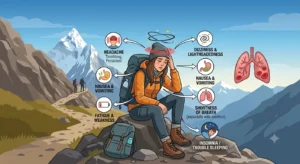
Skipped acclimatisation doesn’t just mean a bad headache. Unaddressed AMS is the on-ramp to High Altitude Pulmonary Edema (HAPE) and High Altitude Cerebral Edema (HACE) — the two altitude illnesses that can be fatal within days or even hours if ignored. We cover the full symptom breakdown and treatment protocol in Altitude Sickness in Nepal: Prevention, Symptoms & Treatment — but the short version is that almost every severe case traces back to the same root cause: ascending faster than the body’s acclimatisation timeline allows.
Building It Into Your Itinerary
Don’t compress a trekking itinerary to fit a flight home. This is the single most common reason acclimatisation days get skipped, and it’s entirely avoidable by booking a longer trip or a flexible return date.
Treat rest days as active, not lazy. Use them for a day hike to a higher point — Kyanjin Ri from Kyanjin Gompa, the Everest View Hotel from Namche, Ice Lake from Manang — then return to sleep lower. This does more for your acclimatisation than sitting in a teahouse all day.
Hydrate on a schedule. Altitude suppresses your thirst signal well before your body actually needs water, so drinking 3–4 litres a day by routine — not by feeling thirsty — supports the acclimatisation process your blood is going through.
Consider pre-acclimatisation if your schedule is tight. Sleeping at elevation (a mountain town before your trek starts) or structured hypoxic training in the weeks before departure both have real evidence behind them, though neither replaces proper pacing once you’re on the trail.
Signs You Need More Time, Not More Painkillers
A headache that responds to rest, fluids, and time at the same altitude is your body asking for exactly what acclimatisation days are for. Persistent headache, nausea, or fatigue that doesn’t improve after 24 hours at the same elevation is a signal to stay put another day, not to push through with medication and continue climbing. Any confusion, loss of coordination, or breathlessness at rest means immediate descent — not an extra rest day, an actual drop in elevation.
The Bottom Line
Acclimatisation isn’t the part of the itinerary you can trim to save time — it’s the part that determines whether the rest of the itinerary happens at all. The trekkers who reach Base Camp, Kyanjin Ri, or Thorong La aren’t necessarily the fittest people on the trail. They’re the ones who let their blood chemistry catch up to their ambition.