Vacationing in Nepal: The Ultimate Travel Guide to the Himalayas (2026)
Your complete guide to Nepal travel — from the streets of Kathmandu to the summit of Everest Base Camp.
Why should Nepal be your next vacation destination?
Few places on Earth pack as much wonder into one border as Nepal.
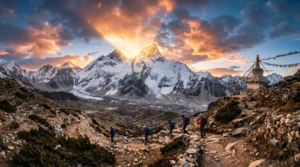
Here, you can watch the sunrise paint Mount Everest gold from a tea house at 3,000 meters. You can weave through ancient alleyways where temples older than most nations still see daily offerings of marigolds and incense. You can paraglide over a mirror-calm lake, white-water raft through jungle gorges, and share a meal of dal bhat with a Sherpa family who has lived beneath the world’s highest peaks for generations.
Nepal is not just a destination. It is an experience that changes you.
And now is one of the best times to go. Nepal welcomed 1,158,459 international visitors in 2025 — nearly reaching its pre-pandemic peak — and tourism is accelerating heading into 2026. The country has invested in new airports, better trails, and improved infrastructure. The world has rediscovered this Himalayan kingdom, and it is not hard to see why.
This guide covers everything you need to know about vacationing in Nepal: the top cities, the best treks, the culture, the people, the weather, and the adventure activities that make this country truly one of a kind.
Nepal at a Glance: Culture, People, and Way of Life
A Land of Living Traditions
Nepal is home to over 125 ethnic groups and more than 120 languages. That diversity shows up everywhere — in the food, the festivals, the architecture, and the music.
The majority of Nepalis follow Hinduism, while Buddhism has deep roots across the Himalayan regions. Remarkably, the two coexist in a way that feels organic rather than imposed. You will find Hindu shrines and Buddhist stupas sitting side by side, and many locals honor both traditions without conflict.
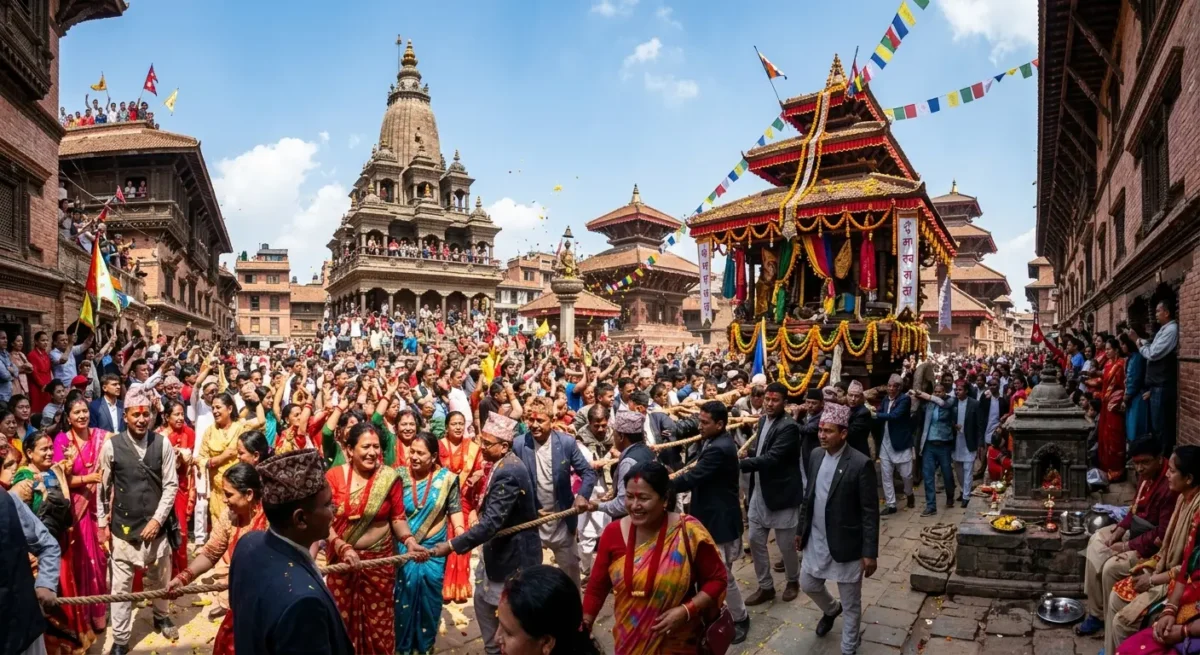
Festivals are central to Nepali life. Dashain, the country’s biggest Hindu festival, fills the streets with family reunions, kite flying, and the blessing of elders. Tihar, the festival of lights, transforms cities into glowing celebrations over five days. Indra Jatra in Kathmandu brings ancient chariot processions and masked dancers into the old city squares. If you can time your trip around one of these events, do it.
The Nepali People: Warm, Resilient, Welcoming
Travelers consistently say the same thing about Nepal: the people make the trip.
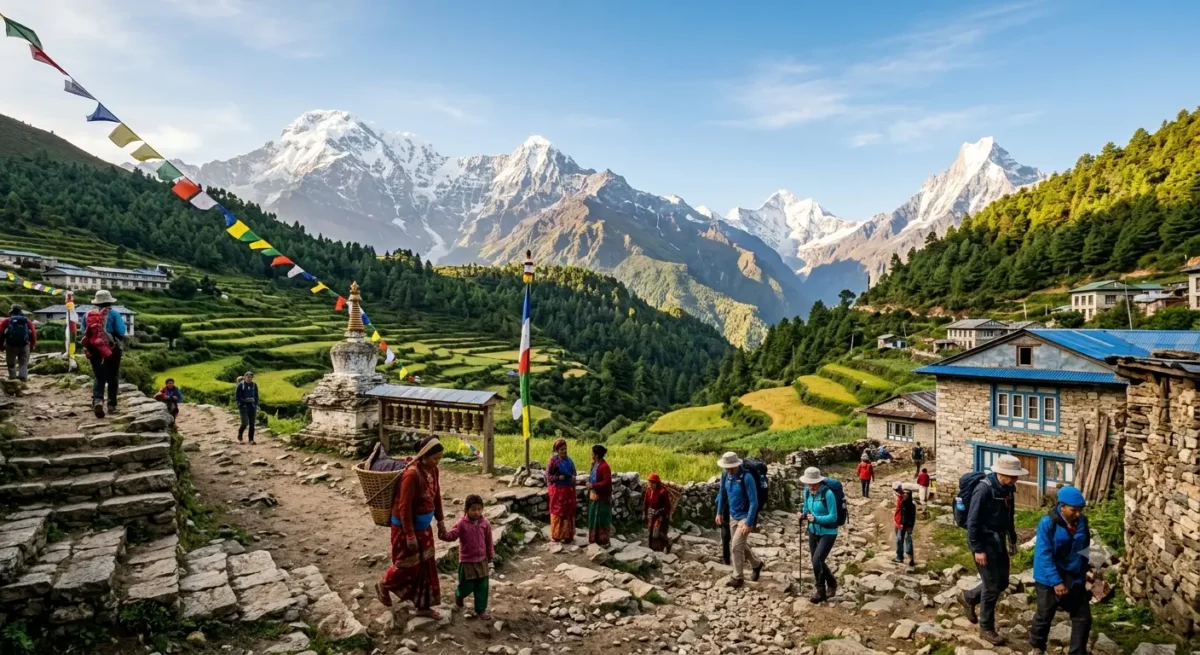
Nepalis greet strangers with Namaste — hands pressed together, a slight bow — and the warmth behind that gesture is genuine. In mountain villages, locals will invite you in for tea without hesitation. Sherpa guides carry not just your bag but a sense of calm and humor that gets you through the hardest days on the trail.
The Sherpa community, whose name has become synonymous with Himalayan guiding, originates from the Solu-Khumbu region in eastern Nepal. Their knowledge of the mountains, their altitude fitness, and their cultural generosity are unlike anything else in the world.
Food: Simple, Nourishing, and Deeply Satisfying
Nepali food centers on dal bhat — steamed rice, lentil soup, and vegetable curry — eaten twice a day across the country. It sounds simple. It is deeply satisfying, especially after a long day of trekking.
Beyond dal bhat, you will find momos (dumplings filled with meat or vegetables), thukpa (Tibetan noodle soup), and sel roti (a sweet fried rice bread popular at festivals). In Kathmandu and Pokhara, international restaurants serving everything from Italian to Japanese are widely available.
Weather in Nepal: When to Go and What to Expect
Nepal has four distinct seasons that dramatically affect the travel experience.
Spring (March–May) is one of the two best times to visit. Temperatures are mild, the rhododendron forests bloom in vivid red and pink, and the skies are clear. This is also the prime mountaineering season — dozens of expeditions attempt Everest each May.
Monsoon (June–August) brings heavy rainfall, lush green landscapes, and significantly fewer tourists. Trails get slippery and flights can be delayed. Experienced travelers who want solitude and dramatic cloud-covered scenery sometimes prefer this season, but it requires flexibility.
Autumn (September–November) is the most popular trekking season. The monsoon clears, leaving crystalline skies and sharp mountain visibility. October is peak season — and for good reason. The weather is near-perfect for trekking, and festivals like Dashain and Tihar light up the country.
Winter (December–February) brings cold temperatures at altitude but clear skies at lower elevations. Kathmandu and Pokhara are perfectly pleasant in winter. High-altitude treks become challenging but possible for well-equipped trekkers seeking solitude.
Top 3 Cities to Visit in Nepal
Kathmandu — The Ancient Capital
Kathmandu is where most Nepal trips begin, and it deserves more than just a transit stop.The city is a living museum. The Kathmandu Durbar Square is a UNESCO World Heritage Site filled with carved wooden temples, royal palaces, and courtyards that date back to the 12th century.
Pashupatinath Temple, one of the holiest Hindu shrines in the world, sits on the banks of the Bagmati River and hosts cremation ceremonies that are both sobering and deeply moving. Boudhanath Stupa — one of the largest stupas in the world — draws Buddhist pilgrims and curious travelers alike to walk its prayer-wheel-lined circumference.
The Thamel neighborhood is the tourist hub: buzzing with gear shops, rooftop cafés, bakeries, and guesthouses. It is a great base to organize your trek, shop for equipment, or simply eat well before heading into the mountains.
Don’t miss: Swayambhunath (the “Monkey Temple”), the Garden of Dreams, and a morning walk through the narrow alleyways of Asan Bazaar.
Pokhara — The Adventure Capital
Pokhara sits on the edge of Phewa Lake with the Annapurna range forming a dramatic backdrop. It is Nepal’s second-largest city and one of the most beautiful lakeside towns in Asia.
This is the launchpad for the Annapurna Circuit and Annapurna Base Camp treks, two of the most popular routes in the Himalayas. But even if you are not trekking, Pokhara delivers.
Paragliding here has exploded in popularity. Foreign tourist paragliding numbers nearly doubled between 2022 and 2024, growing by over 99% in just two years — one of the strongest signals that adventure tourism is booming in Nepal. You launch from Sarangkot Hill and soar above the lake with Annapurna and Machhapuchhre (Fishtail Mountain) directly ahead.
Other activities include white-water rafting on the Seti and Modi rivers, zip-lining, bungee jumping, and kayaking on Phewa Lake at dawn.
Don’t miss: Sunrise from Sarangkot, a boat ride on Phewa Lake to the Tal Barahi Temple, the Peace Stupa, and the Gupteshwor Cave.
Chitwan — Wildlife and Jungle Adventure
Chitwan sits in the lowland Terai region and offers a completely different Nepal from the mountains.
Chitwan National Park is a UNESCO World Heritage Site and home to one-horned rhinoceroses, Bengal tigers, gharial crocodiles, and over 500 species of birds. You can explore it on foot, by elephant, by jeep, or by dugout canoe on the Rapti River.
The Tharu people, indigenous to the Terai, have lived alongside this jungle for centuries. Their stick dance performances and homestay programs offer a cultural experience that feels authentic and unhurried.
Chitwan is typically a 2–3 day stop on the way between Kathmandu and Pokhara, and it rewards everyone who makes time for it.
Don’t miss: A jungle safari at dawn, a canoe ride on the Rapti River, a Tharu cultural show, and bird watching at the edge of the grasslands.
Best Treks in Nepal: Top Recommendations
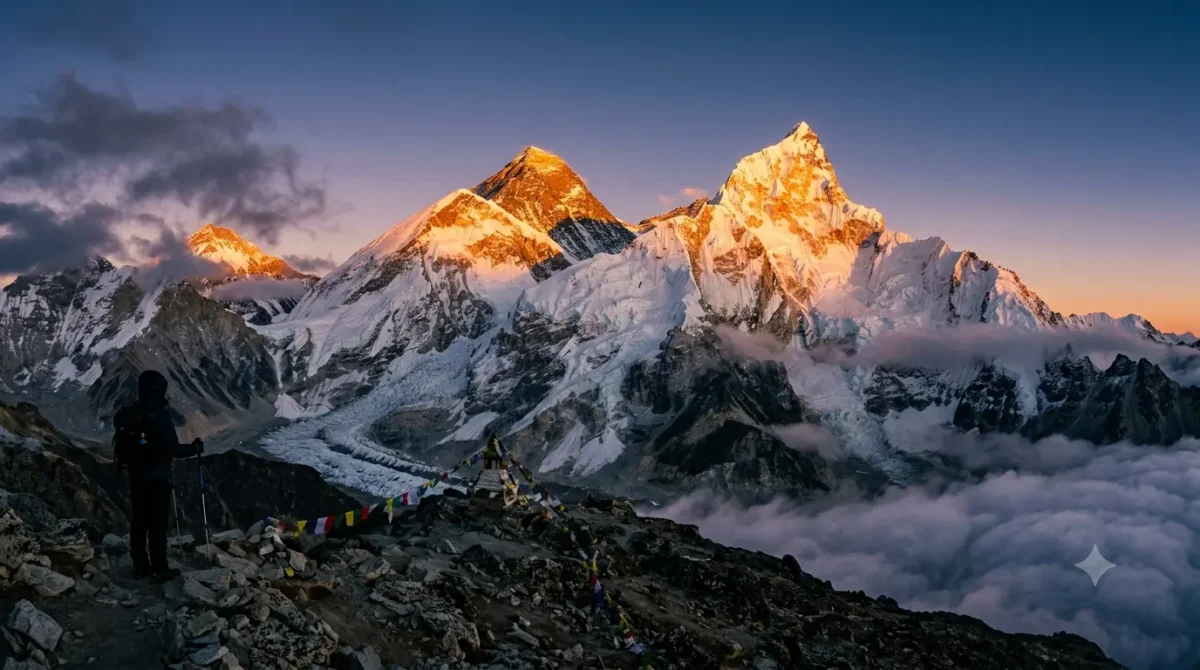
Nepal has some of the greatest trekking routes on the planet. Here are the top three to consider.
1. Everest Base Camp (EBC) Trek — 12–14 Days
Difficulty: Moderate to Challenging | Max Altitude: 5,364 m (Base Camp) / 5,545 m (Kala Patthar)
The most iconic trek in the world. It takes you through Sherpa villages, past Buddhist monasteries, across high suspension bridges, and finally to the foot of the world’s highest mountain. The views from Kala Patthar at sunrise are unforgettable.
2. Annapurna Circuit — 12–20 Days
Difficulty: Moderate | Max Altitude: 5,416 m (Thorong La Pass)
The Annapurna Circuit is Nepal’s most diverse trek, passing through subtropical valleys, rhododendron forests, high alpine desert, and the stunning Thorong La Pass. It covers more varied terrain than any other route and consistently draws the largest share of Nepal’s trekking traffic.
2. Langtang Valley Trek — 7–10 Days
Difficulty: Easy to Moderate | Max Altitude: ~4,984 m (Tserko Ri)
Often called “the valley closest to Kathmandu,” the Langtang trek is ideal for travelers short on time. The Tamang and Tibetan cultures here are distinct and fascinating, and the valley scenery — glaciers, yak pastures, snowy ridges — is spectacular without the crowds of the Everest or Annapurna regions.
Detailed Itinerary: The Everest Base Camp Trek (14 Days)
The Everest Base Camp Trek is the most popular trek in Nepal and one of the most celebrated journeys on Earth. Here is a complete day-by-day itinerary.
Best Seasons: Spring (March–May) and Autumn (September–November)
Starting Point: Lukla (via flight from Kathmandu or Ramechhap)
Endpoint: Lukla (return via same route)
Day 1: Fly Kathmandu to Lukla → Trek to Phakding
Altitude: Lukla 2,830 m → Phakding 2,640 m | Trek: ~8 km, 3–4 hours
Your adventure begins with a thrilling 35-minute mountain flight to Tenzing-Hillary Airport in Lukla — one of the most dramatic landings in the world. From Lukla, you descend gradually through pine forests and cross suspension bridges draped in prayer flags over the rushing Dudh Koshi River, arriving in the village of Phakding for your first night in a teahouse.
Day 2: Phakding → Namche Bazaar
Altitude: 2,640 m → 3,440 m | Trek: ~11 km, 5–6 hours
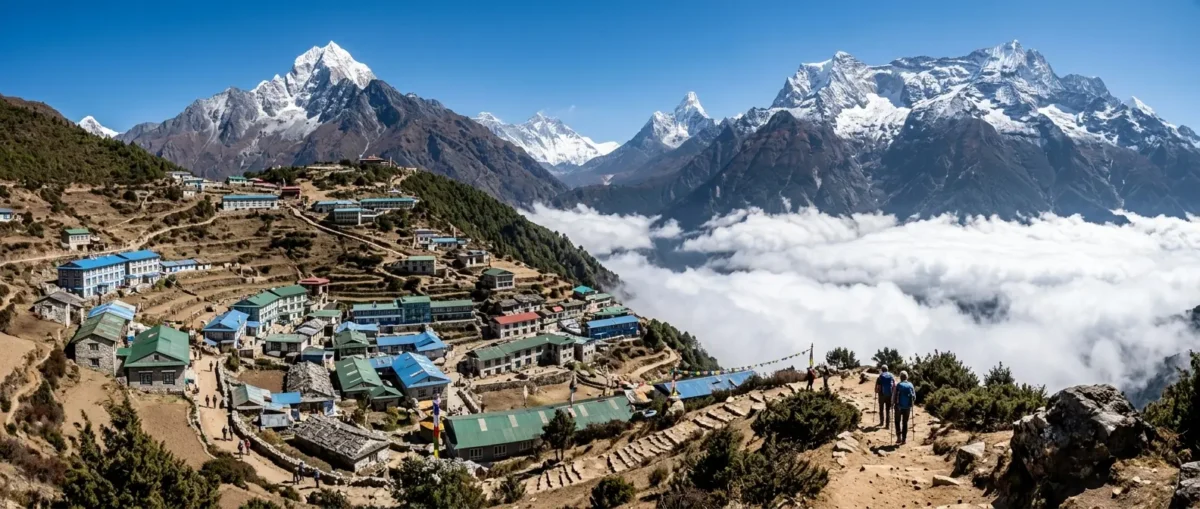
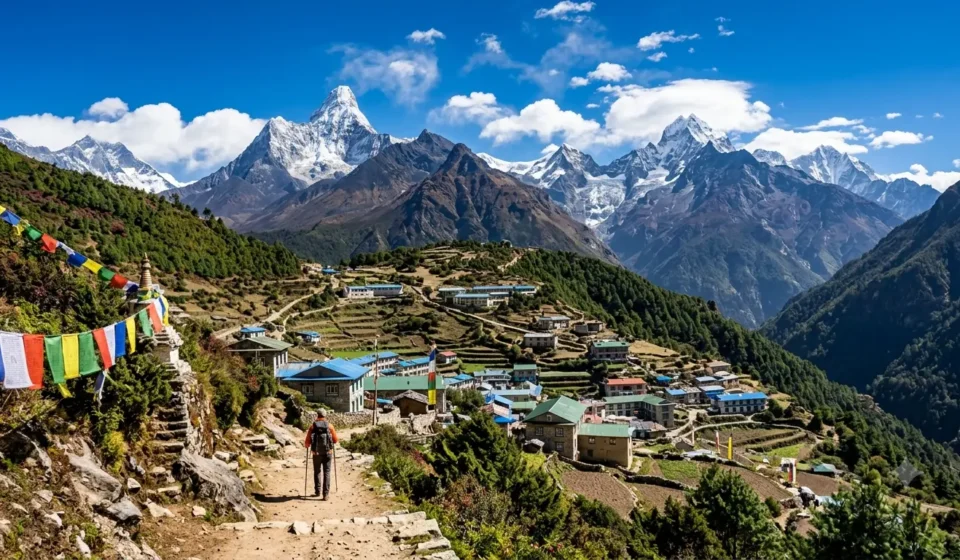
Today is your first significant climb. The trail follows the Dudh Koshi River through Sagarmatha National Park, past the famous Hillary Suspension Bridge, and up a steep ascent to Namche Bazaar — the “gateway to the Everest region.” Namche is a horseshoe-shaped market town clinging to the mountainside, full of bakeries, gear shops, and teahouses. On a clear day, you get your first glimpse of Everest.
Day 3: Acclimatization Day in Namche Bazaar
Altitude: 3,440 m
Do not skip this day. Acclimatization is what keeps you healthy and on the trail. Hike up to the Everest View Hotel (3,880 m) for your clearest early view of Everest, Lhotse, and Ama Dablam. Explore the Sherpa Culture Museum and the Saturday market. Rest, hydrate, and eat well.
Day 4: Namche Bazaar → Tengboche
Altitude: 3,440 m → 3,867 m | Trek: ~10 km, 5 hours
The trail contours above the valley with breathtaking views of Everest, Nuptse, Lhotse, and the iconic pyramid of Ama Dablam. You descend to the Dudh Koshi River and climb again to the Tengboche ridge. The Tengboche Monastery — the largest in the Khumbu — sits in one of the most dramatic settings in the Himalayas. Arrive in time for the evening prayer ceremony if possible.
Day 5: Tengboche → Dingboche
Altitude: 3,867 m → 4,260 m | Trek: ~11 km, 5–6 hours
The trail descends to the river, then climbs steadily through rhododendron and juniper forests. You pass through the village of Pangboche (home to an ancient monastery said to hold a Yeti skull) before ascending to Dingboche, set in an open valley ringed by massive peaks.
Day 6: Acclimatization Day in Dingboche
Altitude: 4,260 m
Your second essential rest day. Hike up to Nangkartshang Peak (5,083 m) for panoramic views of Makalu, Cho Oyu, Lhotse, and Island Peak. This hike doubles as altitude preparation for the days ahead. Spend the afternoon resting, reading, and drinking fluids.
Day 7: Dingboche → Lobuche
Altitude: 4,260 m → 4,930 m | Trek: ~8 km, 5 hours
A challenging climb through stark, high-altitude terrain. You pass the Thukla Memorial — a ridge scattered with stone memorials to climbers who died on Everest — a powerful and sobering moment. The landscape above the tree line becomes increasingly raw and glacial. Lobuche is a small collection of teahouses perched near the edge of the Khumbu Glacier.
Day 8: Lobuche → Gorak Shep → Everest Base Camp → Gorak Shep
Altitude: 4,930 m → Gorak Shep 5,170 m → EBC 5,364 m | Trek: ~13 km, 6–7 hours
The big day. After breakfast, you trek across the lateral moraine of the Khumbu Glacier to Gorak Shep — the last stop. Drop your bag, eat lunch, and continue to Everest Base Camp at 5,364 meters. You stand at the foot of the world’s highest mountain. The colorful tents of expedition teams dot the glacier during climbing season. The scale is incomprehensible. Return to Gorak Shep for the night.
Day 9: Gorak Shep → Kala Patthar → Pheriche
Altitude: Peak at Kala Patthar 5,545 m → Pheriche 4,240 m | Trek: ~15 km, 7–8 hours
Wake before dawn. Climb Kala Patthar (5,545 m) as the sun rises over Everest. This is the single greatest viewpoint of Mount Everest accessible without climbing equipment — a panorama of Everest, Nuptse, Lhotse, and the Khumbu Icefall in full morning light. Photographs will not do it justice. Descend all the way to Pheriche for the night, enjoying the altitude dropping as you go.
Day 10: Pheriche → Namche Bazaar
Altitude: 4,240 m → 3,440 m | Trek: ~16 km, 6–7 hours
The descent passes through familiar terrain — Pangboche, Tengboche, and down to Namche. With altitude working in your favor, you will move quickly and your body will feel the difference. Celebrate the night in Namche with a proper meal and well-earned rest.
Day 11: Namche Bazaar → Lukla
Altitude: 3,440 m → 2,840 m | Trek: ~19 km, 6–7 hours
The longest day of the return, but mostly downhill. Back through the national park, past the Hillary Bridge, through Phakding, and the final climb back up to Lukla. The teahouses here feel like luxury after the high altitude. Celebrate with your guide and fellow trekkers.
Day 12: Fly Lukla → Kathmandu
Altitude: Return to sea level
Morning flights from Lukla to Kathmandu (or Ramechhap). Weather permitting, you are back in the capital by mid-morning. Spend the afternoon with a hot shower, a real bed, and a meal that does not involve instant noodles. You have earned it.
Optional Days 13–14: Kathmandu Sightseeing
Use remaining days for Kathmandu’s UNESCO heritage sites — Pashupatinath, Boudhanath, Swayambhunath, and Durbar Square — before your international flight home.
Adventure Activities Beyond Trekking
Nepal’s adventure offerings extend well beyond mountain trails.
Paragliding in Pokhara has become one of Nepal’s must-do experiences. You launch from Sarangkot and soar in thermals with the Annapurna range at eye level — a surreal sensation that lasts 20–45 minutes.
White-Water Rafting on rivers like the Trishuli, Bhote Koshi, and Sun Koshi ranges from family-friendly rapids to multi-day Class IV–V expeditions. Nepal’s glacial rivers are among the best for rafting in Asia.
Bungee Jumping at the Last Resort near the Tibetan border — a 160-meter free fall over a canyon — is one of the highest bungee jumps in the world.
Mountain Biking through the valley roads around Kathmandu and Pokhara offers a fast-paced way to explore rural Nepal between cities.
Wildlife Safaris in Chitwan and Bardia National Parks bring you close to rhinos, tigers, crocodiles, and diverse birdlife in the lowland jungle.
Yoga and Meditation Retreats are widely available in Pokhara and Kathmandu, making Nepal a natural destination for travelers seeking both physical and spiritual rejuvenation.
Nepal Tourism in 2026: What’s Trending Right Now
Nepal’s tourism sector is at a fascinating inflection point.
Record visitor numbers are returning. Nepal welcomed 1,158,459 international tourists in 2025 — 96.8% of its pre-pandemic peak — with projections of 1.3 to 1.5 million arrivals in 2026 potentially surpassing pre-COVID levels.
Adventure tourism is the fastest-growing segment. Paragliding numbers in Pokhara nearly doubled in two years. New routes like Manaslu, Kanchenjunga, and Dolpo are gaining traction among trekkers looking to escape crowded trails.
The season is shifting. Travelers are increasingly choosing January through April over the traditional October-November window. January 2026 recorded the highest monthly arrivals in four years. This is good news for travelers — shoulder seasons mean less crowded trails, lower prices, and more teahouse availability.
Indian and American visitors are driving growth. India remains Nepal’s largest source market, contributing over 25% of all arrivals. The United States has consolidated its position as the second-largest market with over 112,000 visitors in 2025 — and that number is climbing.
Sustainable and off-the-beaten-path tourism is rising. The Mustang region saw an 18.71% increase in foreign tourists in 2025. Eco-lodges, community homestays, and rural tourism initiatives are seeing strong investment as travelers seek meaningful, less commercial experiences.
New infrastructure is opening doors. The Pokhara International Airport has improved accessibility to the country’s adventure capital, with new flight routes expanding connectivity for international visitors.
Practical Tips for Vacationing in Nepal
Visa: Most nationalities can get a tourist visa on arrival at Tribhuvan International Airport in Kathmandu. A 30-day visa costs USD $30.
Currency: Nepali Rupee (NPR). USD, EUR, and GBP are easily exchanged in Kathmandu and Pokhara. ATMs are available in major cities.
Trekking Permits: For most major treks, you need a TIMS (Trekkers’ Information Management System) card and a national park/conservation area permit. Your trekking agency handles these.
Health: Altitude sickness is the main concern for trekkers. Ascend slowly, stay hydrated, and do not push through symptoms. Diamox (acetazolamide) can help — consult your doctor before travel. Get vaccinations for Hepatitis A and B, typhoid, and tetanus. Travel insurance with helicopter evacuation coverage is essential.
Best Time to Visit: October–November for trekking (peak season); March–May for trekking with rhododendron blooms; December–February for lower-elevation sightseeing.
Connectivity: SIM cards are cheap and widely available. Ncell and NTC offer decent coverage. Teahouses along major trekking routes have WiFi (quality varies).
Budget: Nepal is affordable. A comfortable mid-range budget is USD $50–80/day in cities; teahouse trekking costs USD $30–60/day including accommodation and meals on the trail.
Why Nepal Belongs on Your Bucket List
There is a reason Nepal keeps appearing at the top of every serious traveler’s list.
It is the only place on Earth where you can stand in front of the world’s highest mountain, share tea with a Sherpa who has summited it, walk to a 10th-century Buddhist monastery, and paraglide over a Himalayan lake — all within two weeks.
Nepal is not a place you visit once. It is a place that pulls you back.
Whether you are a first-time traveler looking for culture and mountain views, or a seasoned adventurer chasing a trek that tests your limits, Nepal delivers. And in 2026, with the country firing on all cylinders — new airports, growing trails, a booming adventure scene — there has never been a better time to go.