Everest Base Camp Trek Cost 2026: The Complete Budget Breakdown
You search “Everest Base Camp trek cost” and three wildly different numbers stare back at you: $999, $1,800, $4,500.
Same mountain. Same trail. Same two weeks.
Which number is real?
All of them — and none of them. The Everest Base Camp trek cost in 2026 is not a single figure. It is a stack of costs: your package, your permits, your Lukla flights, food that gets pricier with every step up the valley, and a list of extras no one mentions until you are paying $5 to charge your phone at 5,000 meters.
This guide breaks every cost down, line by line. By the end, you will know exactly what you should budget, where to save without compromising safety, and what the quoted price almost never includes.
The short answer: Budget $1,800 to $2,200 for a comfortable, fully guided 14-day EBC trek — all in, flights, insurance, permits, food. That is the real number for most international trekkers, not the brochure price.
Quick Reference: EBC Trek Cost Summary for 2026
| Trek Style | Package Cost | All-In Budget (From Kathmandu) |
|---|---|---|
| Independent (no guide) | $0 | $1,000 – $1,500 |
| Budget guided package | $950 – $1,400 | $1,400 – $1,900 |
| Standard guided package | $1,400 – $2,200 | $1,800 – $2,800 |
| Premium guided package | $2,500 – $4,000 | $3,200 – $5,000 |
| Luxury with helicopter return | $3,500 – $5,500+ | $4,500 – $7,000+ |
All-in budget includes package, Nepal visa, travel insurance, tips, trail extras, and Kathmandu hotel nights. International flights are excluded.
What Drives the Cost of the EBC Trek?
First, guided or independent. Going without a guide saves $400 to $700 on paper. In practice, you still pay for permits, flights, accommodation, and food. The savings narrow fast. More importantly, Nepal regulations now require foreign trekkers to have a licensed guide in most regions, including the Everest area. Independent trekking without a licensed guide is increasingly restricted, and illegal in several adjacent zones. Verify the current regulation before you go.
Second, accommodation and food standard. This is where most of the middle range of the price spread lives. A basic teahouse at Gorak Shep and a premium lodge in Namche are on the same trail, but they cost very different things. What you eat, where you sleep, and how often you pay for hot showers determines a large chunk of your daily spend.
Third, add-ons. The helicopter return from Gorak Shep, a private guide, an extra acclimatization day, a Kala Patthar sunrise — these are decisions that move you up the price scale meaningfully. Know which ones matter to you before you book.
The Full Cost Breakdown: Every Expense on the EBC Trek
1. The Trekking Package
A package from a travel agent covers the core logistics: guide, porter, teahouse accommodation, most meals, permits, and Lukla flights. What it does not cover: personal trail expenses, tips, travel insurance, Nepal visa, gear, and international flights to Kathmandu.
Here is how packages are structured:
Budget packages ($950 – $1,400 per person) cover the essentials. A licensed guide, porter, basic teahouse accommodation, meals on the trail, and permits. Shared rooms throughout. Practical and safe, but with less comfort and flexibility.
Standard packages ($1,400 – $2,200 per person) are where most international trekkers land. Private or twin rooms where available, experienced senior guides, better meal options, and full logistics handled. This is the sweet spot for first-time EBC trekkers.
Premium packages ($2,500 – $4,000 per person) add higher-end teahouses, smaller group sizes, private guides, and dedicated porter support. Particularly worth considering if you are trekking solo and want a dedicated guide all to yourself.
Luxury packages ($3,500 – $5,500+ per person) include premium lodge accommodation with private bathrooms, private guides and porters, helicopter return from Gorak Shep, gourmet meals, Kathmandu hotel upgrades, and sometimes spa access at select lodges.
One important rule: if a 14-day guided EBC package is priced under $800, something is missing. Mathematically, you cannot cover guide wages, porter wages, Lukla flights, permits, and accommodation at that price without cutting corners or underpaying staff. Book with a TAAN-certified agency and ask for an itemized inclusion list before paying anything.
2. Nepal Visa
Most nationalities obtain a Nepal visa on arrival at Tribhuvan International Airport in Kathmandu.
- 15-day visa: $30 USD
- 30-day visa: $50 USD
- 90-day visa: $125 USD
For a standard 14-day EBC trek, the 30-day visa ($50) is the right choice. It gives you buffer days before and after the trek — crucial because Lukla flight delays are common and you do not want to be rushing your international connection.
Indian passport holders do not need a visa for Nepal.
3. Trekking Permits
Two permits are mandatory for the EBC route. Both are typically arranged by your trekking agency and included in the package price. If you are going independent, you obtain them at the Nepal Tourism Board office in Kathmandu or at the checkpoint in Monjo on the trail.
Sagarmatha National Park Entry Permit: approximately $22 USD (NPR 3,000) for non-SAARC nationals, plus 13% VAT, bringing the effective cost to around $30 USD.
Khumbu Pasang Lhamu Rural Municipality Permit: approximately $15 to $22 USD (NPR 2,000 to 3,000). This replaced the old TIMS card in 2020 and is checked at Lukla and Monjo.
Total permit cost: $37 to $52 USD per person.
Permits are checked at multiple points on the trail. Carry them with you at all times.
4. Lukla Flights
The domestic flight from Kathmandu to Lukla — and back — is the most significant single fixed cost on the trek, and the one most likely to cause budget surprises.
Round-trip Lukla flight cost: $350 to $480 USD for foreign nationals.
In peak season (October and April), flights are sometimes diverted to Ramechhap airport, approximately five hours by road from Kathmandu. This happens to manage air traffic over the valley. The flight itself costs less from Ramechhap, but a private jeep transfer adds $50 to $80 each way, and an early morning departure from Kathmandu means booking an extra hotel night.
Most quality packages include Lukla flights in the price. Confirm this before you sign up — some budget packages list flights as an extra.
Crucially: budget one to two extra days in Kathmandu on either end of your trip for flight delays. Lukla weather changes fast. In peak season, one in every five flight days sees cancellations. Plan your international departure accordingly.
5. Guide and Porter Costs
If you are arranging your own guide and porter independently rather than through a package, here is what to expect in 2026:
Licensed guide: $25 to $45 USD per day depending on experience level. Senior Sherpa guides with high-altitude certifications charge more. In a guided package, the guide cost is bundled in.
Porter: $20 to $30 USD per day. One porter typically carries gear for two trekkers, up to 20 to 25 kg. Ethical operators enforce this weight limit strictly — it is a welfare rule, not a suggestion.
What most packages do not make clear: as the trekker’s employer, you also cover your guide’s and porter’s accommodation and food on the trail. This adds roughly $10 to $20 per day per staff member on top of their wage. Reputable packages bundle this in. Budget operators often do not.
For a solo trekker on a 14-day trek with one guide and one porter, the combined staff cost — including food and accommodation — typically runs $700 to $1,200.
6. Teahouse Accommodation
Teahouses are the backbone of the EBC trail, well all trails in Nepal actually — family-run guesthouses that provide a bed, meals, and enough warmth to survive the Himalayan cold. The quality, price, and comfort change significantly as you gain altitude.
Below Namche Bazaar (Phakding, Monjo): $5 to $15 USD per night. Basic rooms with thin walls and shared bathrooms, but always clean and hospitable.
Namche Bazaar and Tengboche: $10 to $25 USD per night. The best teahouses on the route are here. Some offer private bathrooms, hot showers, and Wi-Fi. Worth upgrading if you have a rest day in Namche.
Above Dingboche (Lobuche, Gorak Shep): $8 to $20 USD per night. Facilities become more basic as altitude rises. Shared squat toilets are common. Hot showers are rare and expensive.
One thing to understand: most teahouses expect you to eat your meals in their dining room. Some offer a free or heavily discounted room if you eat all three meals on-site. If you eat elsewhere, expect to pay full room rate. Over a 14-day trek, total food and accommodation typically runs $350 to $700.
7. Food and Water on the Trail
Food on the EBC trail is hearty, reliable, and climbing in cost with every meter of altitude.
Typical meal prices by altitude:
- Phakding to Namche: $5 to $8 per meal
- Namche to Tengboche: $7 to $10 per meal
- Dingboche and above: $10 to $15 per meal
Dal bhat is your best friend. It is the cheapest, most nutritious item on every teahouse menu. The best thing is, it comes with unlimited refills. It is what your guide and porter eat every day because it works. Order it consistently above 4,000 meters and you will save real money while eating better than most trekkers around you.
Water is a significant hidden cost. A 1-liter bottle costs $1 to $2 in lower villages and rises to $4 per bottle near Gorak Shep. Budget trekkers should bring a water purification bottle or tablets — buying bottled water adds $50 to $150 over the course of the trek and generates significant plastic waste on the trail.
Hot drinks add up too. A cup of tea runs $1 to $2. Coffee is $1.50 to $3. Ginger-lemon-honey tea, the trail cure-all, costs $3 to $4 a glass. These are small amounts individually, but at altitude, you drink constantly. Budget $5 to $15 per day in beverages alone.
8. Travel Insurance
This is the cost most people underestimate — and the one you absolutely cannot skip.
A helicopter evacuation from Gorak Shep to Kathmandu costs $4,000 to $12,000 depending on weather, altitude, and aircraft. An ICU stay in Kathmandu runs $1,000 to $2,000 per day. Without insurance, one bad altitude sickness episode turns your trek into a financial catastrophe.
What your policy must cover:
- Helicopter evacuation to at least 6,000 meters (EBC is 5,364m; Kala Patthar is 5,545m — you want a buffer)
- Emergency medical treatment and hospitalization
- Trip interruption and Lukla flight delays
- Gear loss or damage
What a good policy costs: $80 to $200 USD for most trekkers for a 2 to 3 week trip. Premium policies with dedicated helicopter response (such as Global Rescue) run $400 to $600 but are worth considering if you want the fastest, most reliable emergency response.
One important warning: a “fake rescue” scam has been documented in Nepal in recent years. Some unscrupulous guides exaggerate symptoms to push trekkers into unnecessary helicopter evacuations. The guide and a partner hospital then split the insurance payout. Insurance companies have become stricter as a result. Use a TAAN-certified guide from a reputable agency, and do not agree to evacuation unless you are confident the situation is genuine.
Do not buy a general travel policy that caps altitude at 3,000 meters or excludes “adventure activities.” Read the actual policy document, not the marketing summary.
9. Gear
The EBC trek does not require technical mountaineering equipment, but it does require gear that is warm, waterproof, and functional. Getting this wrong causes blisters, hypothermia, or a failed trek.
Non-negotiable items:
- Waterproof, ankle-supporting trekking boots (broken in before the trip)
- Four-season sleeping bag (rated to at least -10°C)
- Down insulated jacket
- Waterproof outer shell
- Trekking poles
- Moisture-wicking base layers
- Warm hat, gloves, and neck gaiter
- Headlamp
- Water purification
If you are buying everything new: $600 to $1,200, depending on brand and quality.
Rent in Kathmandu’s Thamel district instead. A full gear rental package — sleeping bag, down jacket, trekking poles — runs $40 to $80 for the entire trek. The same items bought new in Europe or North America would cost $400 to $800. Thamel also sells quality replicas and genuine discounted gear at significantly lower prices than Western retail.
Buy your boots from home and break them in for at least three weeks before you fly. Everything else can be acquired or rented in Thamel.
10. Tips for Your Guide and Porter
Tipping is not optional in Nepal’s trekking industry. It is an expected and important part of your guide’s and porter’s income — often representing a meaningful portion of what they earn in a season.
2026 tipping guidelines:
- Guide: $15 to $20 USD per day of trekking ($210 to $280 for a 14-day trek)
- Porter: $10 to $15 USD per day ($140 to $210 for a 14-day trek)
Tips are given at the end of the trek, in cash, usually in an envelope during a small informal ceremony. In a group, pool contributions and present them together. If your guide went above and beyond — monitored your oxygen levels, stayed up when you felt unwell, kept your spirits high on a hard day — tip more. It is a genuine difference in their life, not a token gesture.
11. Trail Extras and Hidden Costs
This is where budgets crack. Every item below is small individually. Together, they add $300 to $600 to your total.
Phone and device charging: $2 to $5 per device per charge. A 20,000 mAh power bank fully charged in Namche will cover 4 to 5 days of phone use above it. Worth buying before the trip.
Wi-Fi: $2 to $5 per session. Available at most teahouses, though the quality deteriorates with altitude. In 2026, Starlink satellite internet now covers nearly 90% of the major trail, making connectivity significantly better than it was even two years ago.
Hot showers: $2 to $5 per shower. Solar-heated below Namche; gas-heated above. Above Dingboche, hot showers become scarce.
Snacks: Trail prices for chocolate bars, energy snacks, and Snickers are three to five times what you pay in Kathmandu. Stock up in Thamel before you leave. A bag of dried fruit, nuts, and energy bars from a Thamel shop costs a fraction of altitude prices.
Altitude medication (Diamox): Available in Kathmandu pharmacies. Consult your doctor at home before the trip and carry a course if recommended. Cost is minimal — a key reason to source it at home rather than on the trail.
Lukla flight delay nights: Budget at least one extra night in Lukla ($20 to $40 for accommodation and meals) as a contingency. Delays happen more often than most itineraries acknowledge.
The Luxury Add-On Worth Every Dollar: Helicopter Return
The single most significant upgrade available on the EBC trek is the helicopter return from Gorak Shep to Lukla or directly to Kathmandu.
This eliminates the entire four to five day descent, replaces it with a 45-minute aerial experience over the Khumbu Glacier and Everest’s south face, and saves your knees the punishment of the return trail.
Helicopter return cost from Gorak Shep: $800 to $1,200 per person when booked as part of a package. This is separate from emergency evacuation — it is a scenic return flight, booked in advance, not triggered by a medical emergency.
For travelers with limited annual leave, or anyone who wants to maximize summit views and minimize descending time, this is genuinely worth the premium.
What Your Total All-In Budget Looks Like
Here is what four realistic trekkers actually spend in 2026, from Kathmandu and back.
| Cost Item | Group Trekker (Standard) | Solo Trekker (Premium) | Luxury + Helicopter |
|---|---|---|---|
| Trek package | $1,500 | $2,200 | $4,500 (incl. helicopter) |
| Nepal visa (30-day) | $50 | $50 | $50 |
| Travel insurance | $120 | $150 | $200 |
| Trail extras (food, Wi-Fi, charging, water) | $350 | $400 | $300 |
| Tips (guide + porter) | $250 | $300 | $400 |
| Gear (rented/owned) | $100 (rented in Thamel) | $200 | $0 (already owned) |
| Kathmandu hotel nights | $80 | $120 | $400 (luxury hotel) |
| Total (from Kathmandu) | ~$2,450 | ~$3,420 | ~$5,850 |
International flights are not included in any of these figures. Flights to Kathmandu from the US, UK, or Australia typically run $700 to $1,800 depending on season and booking timing. Book four to five(over even more) months ahead for significant savings.
8 Proven Ways to Save Money on the EBC Trek
Saving money on the EBC trek is about knowing which costs are fixed and which are flexible. Here is where to cut without compromising safety.
1. Book a local Kathmandu agency, not an international operator. The same 14-day EBC trek costs $1,400 to $2,200 through a reputable Nepal-based agency. The same trek arranged through a Western international operator costs a lot more with hidden charges. The experience on the trail is identical. The difference is overheads, office costs, and commission layers. Research TAAN-certified agencies in Kathmandu with strong reviews on TripAdvisor and Google.
2. Trek in shoulder season. March and early November offer near-perfect conditions with fewer crowds, lower teahouse prices, and better Lukla flight availability. Teahouse rates drop 15 to 25% compared to peak October and April. Package prices sometimes follow.
3. Join a group departure. Groups of four to eight share guide and porter costs far more efficiently than solo trekkers. Solo trekkers pay the full guide rate divided by one. Groups of four divide that same cost by four. Savings of $200 to $500 per person are common.
4. Rent gear in Thamel. A sleeping bag, down jacket, and trekking poles rented in Kathmandu costs $40 to $80 for the full trek. Buying the same items new at home costs $400 to $800.
5. Carry a water purification bottle or tablets. Save $80 to $150 compared to buying bottled water on the trail. Eliminates plastic waste too.
6. Buy snacks in Kathmandu. Stock a small bag of energy bars, dried fruit, nuts, and chocolate before you leave the city. The same snack costs three to five times more at altitude.
7. Use a power bank. A 20,000 mAh power bank fully charged in Namche eliminates most charging fees on the upper trail. One good power bank costs $25 to $40 and pays for itself within two days above Namche.
8. Book Kathmandu flights early. International flights to Kathmandu drop 20 to 35% when booked four to five months in advance during peak season. Set fare alerts on Google Flights or Skyscanner.
What You Should Never Compromise On
Saving money on the EBC trek has limits. These are the costs that directly determine whether you reach base camp safely and return home healthy. Do not cut them.
Your guide. A good guide monitors your oxygen saturation before you notice symptoms yourself. They know the signs of altitude sickness at each stage of the route. They have emergency contacts in Kathmandu. They have probably been up this trail dozens of times. This is not a cost to minimize.
Travel insurance. A helicopter evacuation without insurance costs $4,000 to $12,000. Insurance covering helicopter rescue to 6,000 meters costs $80 to $200. The math is elementary.
Acclimatization days. The built-in rest days in Namche and Dingboche are not optional extras. They are what keeps you healthy above 4,000 meters. Do not book a 10-day EBC package to save money. It is not faster — it is just riskier.
Your boots. Blisters or ankle injuries at 5,000 meters are not minor inconveniences. They can end your trek. Invest in quality, waterproof, ankle-supporting trekking boots and break them in thoroughly before you fly.
Frequently Asked Questions
How much does the EBC trek cost in 2026? A standard guided 14-day EBC trek costs $1,400 to $2,200 through a Kathmandu-based agency. Your all-in total from Kathmandu — including permits, insurance, tips, gear, and trail extras — typically lands between $1,800 and $2,800 depending on trek style. International flights to Nepal are additional.
What is the cheapest way to do EBC? Join a group departure with a reputable local agency, trek in shoulder season (March or November), rent gear in Thamel, eat dal bhat, and carry a water purification bottle. The floor for a safe, guided 14-day trek is around $1,200 to $1,400 from Kathmandu.
Do I need a guide for EBC in 2026? Nepal has progressively tightened regulations requiring foreign trekkers to use licensed guides. The Everest region has historically allowed independent trekking, but rules shift. Confirm the current regulation before you plan. Regardless of legality, having a guide above 4,000 meters is a genuine safety decision, not merely a luxury.
What does a guide cost per day on EBC? A licensed guide costs $25 to $45 USD per day in 2026, depending on experience level. Porter costs $20 to $30 USD per day. In a quality package, all staff costs including their food and accommodation are included.
Is it worth paying extra for the helicopter return? For most trekkers with limited annual leave, or anyone who wants to maximize their time at altitude and minimize descent time, yes. The $800 to $1,200 cost of a helicopter return from Gorak Shep saves four to five days of descent and includes a 45-minute aerial view of Everest and the Khumbu Glacier that no trail can match.
What travel insurance do I need for EBC? You need a policy that covers helicopter evacuation to at least 6,000 meters, emergency medical treatment and hospitalization in Nepal, trip interruption and Lukla flight delays, and gear loss. Cost: $80 to $200 for most trekkers. Do not book a general travel policy with a 3,000-meter altitude cap — it will not cover you at EBC.
The Bottom Line
The Everest Base Camp trek is not cheap. But it is far more accessible than most people assume.
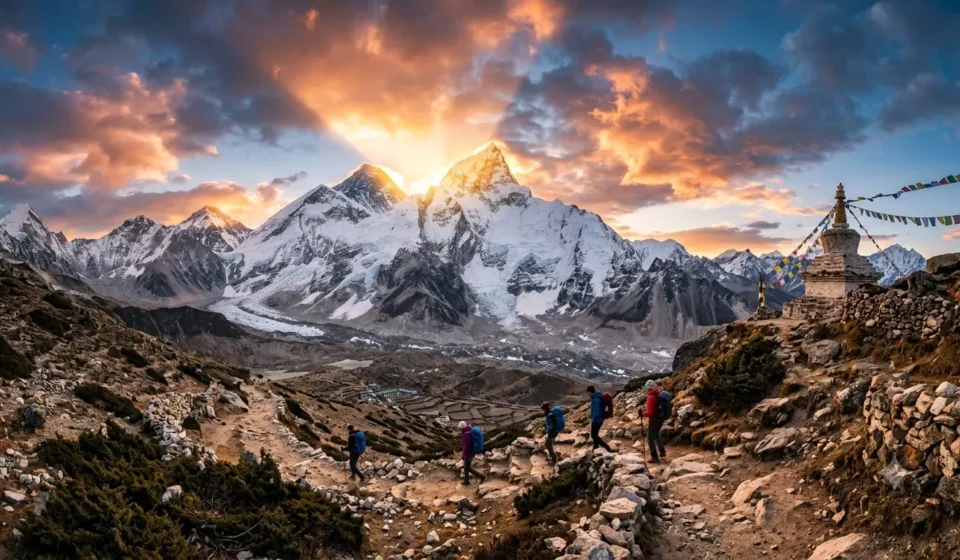
For $1,800 to $2,200 from Kathmandu, you get 14 days in one of the most extraordinary landscapes on Earth. You stand at the foot of the world’s highest mountain. You walk through villages where Sherpa culture has remained largely unchanged for generations. You cross suspension bridges, sleep in teahouses heated by yak-dung fires, and watch the sunrise turn Everest gold from Kala Patthar.
That is not a bad return on $2,000.
The key is planning with the real number in mind — not the brochure price — and knowing exactly where your money goes. This guide gives you that clarity. Now all that is left is booking the trip.
The mountains are waiting.