Nepal Trekking with Kids: A Family Guide
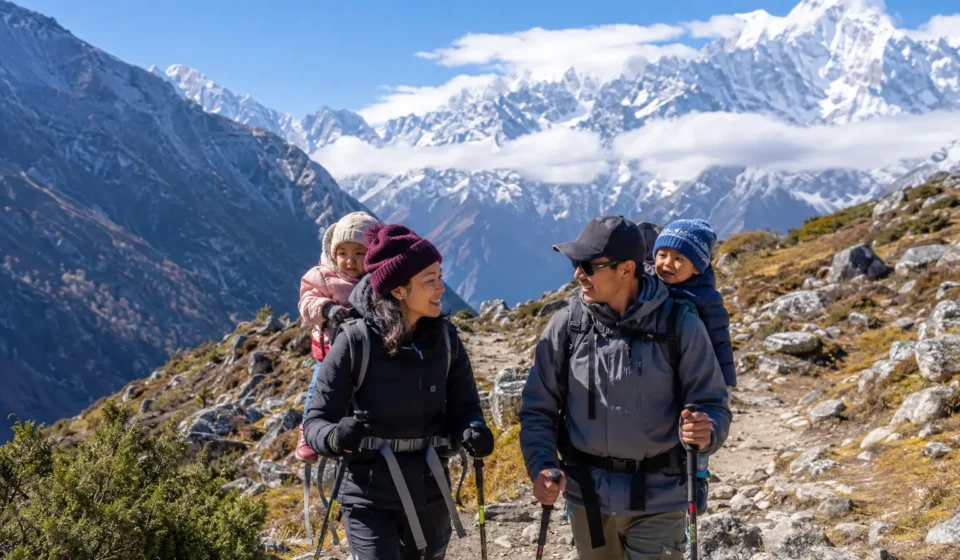
Can you really take children trekking in the Himalayas? Absolutely – families with kids of every age walk Nepal’s trails each season, from toddlers riding in carriers on the Poon Hill circuit to teenagers standing proudly at Everest Base Camp. Nepali culture adores children, tea houses make family logistics far easier than camping, and with the right route the Himalayas become the family adventure your kids will talk about for the rest of their lives. Here’s how to plan it well.
Why Nepal Works for Families
Three things make Nepal unusually family-friendly for a big mountain destination. First, the tea house network: a bed, hot food, and a warm dining room every night means no tents, no cooking, and short escape routes if anyone gets sick or exhausted. Second, flexibility: villages are spaced one to two hours apart on major trails, so you can shorten or lengthen days at will. Third, the people: Nepalis are openly delighted by travelling children, and your kids will be greeted, fussed over, and invited into kitchens the whole way.
Altitude and Kids: The One Rule That Matters
Altitude is the single biggest planning constraint for families. Children get altitude sickness at the same rates as adults, but young kids may not articulate symptoms clearly – a headache can just look like crankiness. Sensible guidelines used by family trekking operators:
- Under 3 years: stay below roughly 2,500-3,000 m.
- Ages 4-9: up to about 3,500-4,000 m with conservative ascent and extra acclimatisation nights.
- Ages 10+: can attempt higher objectives like Everest Base Camp (5,364 m) if fit, motivated, and on an itinerary with generous rest days.
Whatever the age, build in more acclimatisation than an adult itinerary would, ascend slowly, keep kids drinking water constantly, and be ruthlessly willing to descend if symptoms appear. Discuss the trip with your paediatrician, and know that helicopter evacuation insurance for every family member is non-negotiable.
The Best Family Treks in Nepal
Poon Hill (4-5 days, max 3,210 m)
The classic family choice. Short days, low altitude, comfortable lodges, and a sunrise finale over Annapurna and Dhaulagiri that wows every age group. The stone staircase up to Ulleri is the hardest part – break it with plenty of snack stops.
Ghandruk Loop (2-4 days, max 2,000 m)
Perfect for younger children. A gentle circuit through rhododendron forest to one of Nepal’s prettiest Gurung villages, with mountain views that feel touchable and almost no altitude concern.
Langtang Valley (7-8 days, max 3,870 m, optionally higher)
A single valley with a clear trail, friendly lodges, and yak pastures – great for kids 8 and up. Families can stop at Langtang village or Kyanjin Gompa and skip the higher viewpoints.
Everest View Trek (5-7 days, max ~3,880 m)
Fly to Lukla, walk to Namche Bazaar and the Everest View Hotel, see Everest itself without base camp altitudes. Big-mountain drama with manageable heights for kids around 8+.
Everest Base Camp (12-16 days, 5,364 m) – teens only
Doable with fit, keen teenagers on a slow itinerary with two or more acclimatisation days. Make it their goal, not yours – motivation is everything above 4,500 m.
Guides, Porters, and Pace
If there was ever a time to hire help, it’s a family trek. A guide handles route-finding, lodge negotiations, and health monitoring; a porter or two means parents carry only day packs and small children when needed. Expect $25-35 USD per day for a guide and $18-25 for a porter. Some agencies offer child-experienced guides who double as trail entertainers – worth requesting explicitly.
Plan roughly 60-70% of an adult itinerary’s daily distance. Kids trek brilliantly in the morning and fade after lunch, so start early and finish early, leaving afternoons for card games, village exploring, and bakery raids in places like Namche or Chhomrong.
Keeping Kids Happy on the Trail
- Snacks are fuel and morale. Bring familiar bars and sweets from home, and restock chocolate along the way. Bribery by Snickers is a legitimate mountaineering technique.
- Give them jobs: map-checker, prayer-flag counter, official photographer, dal bhat quality inspector. Ownership beats nagging.
- Gamify the walk: spot yaks, count suspension bridges, learn ten Nepali words, collect stamps at checkpoints.
- Other kids are everywhere. Village schools, lodge families, and fellow trekking families provide instant playmates.
- Manage screens strategically: a loaded tablet for evening downtime is fine; the trail itself rarely needs one.
Family Packing Essentials
Everything in your standard packing list applies, plus: proper kids’ trekking shoes worn in beforehand, layered clothing (children lose heat faster than adults), a quality kids’ sleeping bag, sun protection for high-UV altitudes, a child carrier for under-4s, favourite comfort toy, kids’ paracetamol and ibuprofen, oral rehydration salts, and any regular medications in double quantity split between bags. Wet wipes deserve their own line item – bring twice what you think.
Food, Water, and Tummies
Tea house menus are surprisingly kid-friendly: pancakes, pasta, fried rice, momos, chips, porridge, and eggs everywhere. Dal bhat with mild curry wins over most kids by day three. Stick to purified water (tablets, filter, or SteriPEN rather than bottled plastic), avoid meat at altitude, and go easy the first days so small stomachs adjust. A mild stomach bug is the most common family trek illness – hence the rehydration salts.
Costs for a Family
Budget $35-45 USD per person per day for lodges and food, plus guide and porter costs shared across the family. A week-long Poon Hill family trek for four, including Pokhara transport, permits, guide, and one porter, typically lands around $1,200-1,800 total – remarkable value for a Himalayan holiday.
Final Thoughts
Trekking Nepal with kids asks more planning than a beach holiday and repays it a hundredfold. Choose an age-appropriate route, respect altitude rules absolutely, hire good local help, walk short days, and let the trail do what it does: turn children into adventurers. The mountains are patient – start small this year, and Everest Base Camp will still be there when they’re teenagers