Tea House Trekking in Nepal: What to Expect
Wondering what tea house trekking in Nepal is really like? Rooms, food, showers, Wi-Fi, costs and etiquette – everything to expect on the trail.
One of the things that makes trekking in Nepal unlike anywhere else in the world is that you don’t need to carry a tent, a stove, or a week’s worth of food. Along almost every major trail in the Himalayas, a network of family-run lodges known as tea houses offers trekkers a bed, hot meals, and a warm dining room at the end of every walking day. Tea house trekking is the classic Nepali experience – but if you’ve never done it, it helps to know exactly what you’re walking into. This guide covers everything: the rooms, the food, the bathrooms, the costs, and the unwritten rules of tea house life.
What Exactly Is a Tea House?
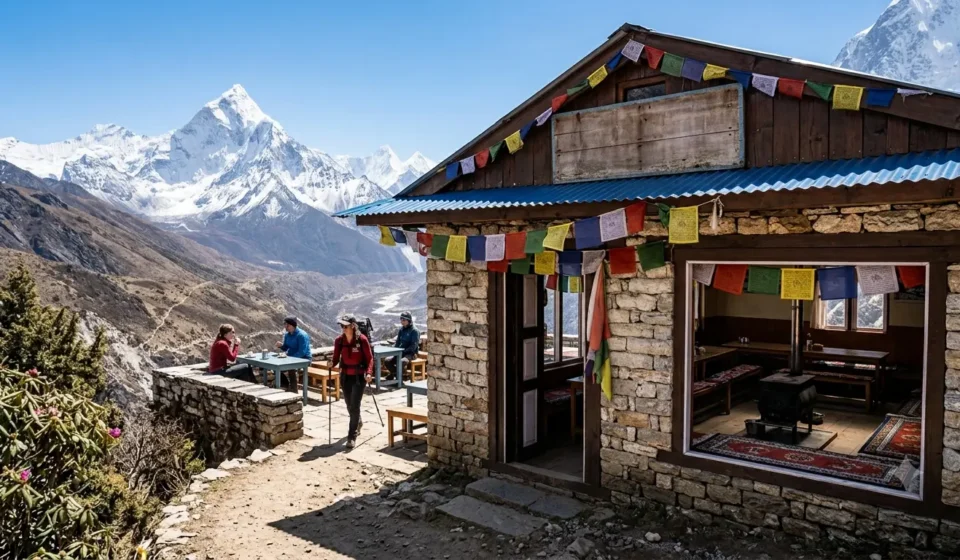
A tea house (also called a lodge) is a simple guesthouse run by a local family, usually built alongside the trail in villages that have served travellers and traders for generations. The name comes from a time when these were literally houses that served tea to passing porters and pilgrims. Today they range from very basic stone buildings with plywood-walled rooms to surprisingly comfortable lodges with hot showers, bakeries, and espresso machines – especially in the Everest and Annapurna regions.
On popular routes like the Everest Base Camp trek or the Annapurna Circuit, you’ll find tea houses every one to two hours of walking, so you never need to commit to a rigid schedule. On remote treks such as Manaslu or Upper Mustang, they are more spread out and more basic, and on true wilderness routes you may still need camping support.
The Rooms: Simple, Clean, and Cold
A standard tea house room is a twin: two narrow wooden beds, each with a foam mattress, a pillow, and a blanket. Walls are thin – often a single sheet of plywood – so earplugs are a genuinely useful piece of gear. Rooms are almost never heated. At lower elevations this hardly matters, but above 3,500 m the nights get seriously cold, and you’ll want a four-season sleeping bag rated to at least -10°C even though blankets are provided.
Expect to pay NPR 500-1,000 (roughly $4-8 USD) per room per night at most elevations, though prices rise with altitude – near Everest Base Camp a room can cost $10-15 or more in peak season. Many lodges will discount the room heavily, or even offer it free, if you eat dinner and breakfast where you sleep. That is the core economics of tea house trekking: the food is where the family makes its living, so eating where you stay is both expected and polite.
Booking Ahead vs. Walking In
For most of the year you can simply walk in and ask for a room. In peak season (October-November and March-April) the busiest villages – Namche Bazaar, Tengboche, Manang, Ghorepani – can fill up by mid-afternoon. If you’re trekking with a guide, they’ll usually phone ahead. Solo trekkers should aim to arrive in villages by 3-4 pm during peak months.
The Food: Dal Bhat Power, 24 Hour
Every tea house has a menu that looks remarkably similar to every other tea house menu, because most are supplied by the same porter and mule trains. The undisputed king is dal bhat: rice, lentil soup, curried vegetables, and pickles, usually with free refills. It’s nutritious, filling, and the safest bet on any menu because it’s cooked fresh in volume. The trail joke – “Dal bhat power, 24 hour” – exists because trekkers genuinely run better on it.
Beyond dal bhat you’ll find fried rice, noodle dishes (chow mein and thukpa), momos (Tibetan dumplings), pasta, pancakes, porridge, eggs every way, and even pizza in bigger villages. A few practical tips:
- Meat gets riskier with altitude. It’s carried up unrefrigerated, sometimes for days. Many experienced trekkers go vegetarian above Namche or Chame.
- Food prices climb with elevation – a meal that costs $3 low down may cost $7-8 high up. Budget $25-35 USD per day for three meals as you get higher.
- Hot drinks are your friend. A big thermos of ginger lemon honey tea is the standard evening ritual and helps with hydration at altitude.
Bathrooms, Showers, and Charging
Bathrooms are usually shared and range from Western flush toilets at lower elevations to squat toilets over a long drop higher up. Toilet paper is never provided – carry your own roll and a lighter or bag to pack it out where required.
Hot showers exist on all the main routes, usually gas-heated, for NPR 300-800 ($2.50-6). Above 4,000 m a “shower” may be a bucket of hot water, and many trekkers switch to wet wipes for the coldest days. Electricity for charging phones and batteries is available almost everywhere but costs money in the hills – typically NPR 200-500 per device – because most villages run on micro-hydro or solar. A power bank saves you a small fortune.
Wi-Fi is widespread on the Everest trail (via prepaid Everest Link cards) and patchy elsewhere. An NTC or Ncell SIM with a data package often works better than lodge Wi-Fi on the Annapurna side.
Evenings in the Dining Room
The heart of every tea house is the dining room, warmed by a central stove that gets lit around 5 pm – often burning yak dung above the treeline, where wood is scarce. This is where trekkers from a dozen countries swap trail news, play cards, read, and eat dinner together. It’s also the only warm room in the building, so everyone lingers until bedtime. Some of the best memories of any Nepal trek happen here, not on the passes.
A few pieces of tea house etiquette worth knowing: order dinner an hour or so before you want it, as everything is cooked to order on a small stove; settle your bill the evening before an early start; don’t bring outside food into the dining room; and don’t occupy the seats closest to the stove all evening if elderly trekkers or porters need to dry out.
How Much Does Tea House Trekking Cost Overall?
For accommodation and food combined, most trekkers spend $30-45 USD per person per day on the main routes – less in the low country, more above 4,000 m and in the Everest region. Add hot showers, charging, Wi-Fi, and the occasional Snickers bar and a comfortable daily budget is $40-50. That makes Nepal one of the best-value mountain destinations on Earth: a comparable hut-to-hut trip in the Alps costs three to four times as much.
Tea House vs. Camping Treks
Camping treks still exist for remote regions like Dolpo or the far west, but on any established route tea houses win for most people: they’re cheaper, warmer, more social, and they put money directly into mountain communities. The trade-off is less privacy and simpler comforts. If you can live with plywood walls and a shared toilet, the tea house is one of the great institutions of world trekking.
Final Thoughts
Tea house trekking is what makes Nepal accessible to ordinary hikers. You walk with a light pack, sleep in a bed every night, eat hot cooked meals, and share the trail’s rhythm with a rotating family of fellow trekkers. Come prepared for cold rooms and simple menus, bring a good sleeping bag and a power bank, eat where you sleep, and order the dal bhat. The mountains will take care of the rest.