Shey Phoksundo Lake Trek: The Complete 2026 Guide to Nepal’s Deepest Lake
Some lakes you photograph. Shey Phoksundo you stand in front of, silent, wondering if water is actually allowed to be that blue. Sitting at 3,611 meters in Nepal’s remote Dolpo region, Shey Phoksundo is the deepest lake in Nepal — and the centerpiece of one of the country’s most rewarding moderate treks. Unlike the busy trails to Everest Base Camp or around the Annapurna Circuit, this route sees only a few thousand trekkers a year. You’ll walk through cedar forests, past Nepal’s highest waterfall, and into villages where the pre-Buddhist Bon religion is still practiced daily.
This guide covers everything you need to plan the Shey Phoksundo Lake trek: the route, a day-by-day itinerary, permits, real costs, difficulty, best seasons, and the cultural context that makes Dolpo unlike anywhere else in the Himalayas.
Key Takeaways
- Location: Dolpa district, Karnali Province, western Nepal, inside Shey Phoksundo National Park
- Lake elevation: 3,611 m (11,849 ft) — Nepal’s deepest lake at roughly 145 m deep
- Duration: 7–11 days from Kathmandu, including flights
- Difficulty: Moderate — no high passes; remoteness is the main challenge
- Permits: Shey Phoksundo National Park permit (NPR 3,000) + Lower Dolpo restricted area permit (USD 20/week)
- Best time: March–May and September–November
- Typical cost: USD 1,400–1,900 per person with a registered agency
Where Is Shey Phoksundo Lake and Why Is It Special?
Shey Phoksundo Lake sits in the Dolpa district of Karnali Province, in Nepal’s far northwest, at an elevation of 3,611 meters. It is an alpine, oligotrophic (nutrient-poor, crystal-clear) freshwater lake, and with a measured depth of around 145 meters, it is the deepest lake in Nepal.
The lake lies inside Shey Phoksundo National Park — Nepal’s largest national park, established in 1984 and covering 3,555 square kilometers across the Dolpa and Mugu districts. The park protects some of the last strongholds of the snow leopard, along with blue sheep, musk deer, Himalayan black bear, and the red panda. In September 2007, the lake was designated a Ramsar Site, recognizing it as a wetland of international importance.
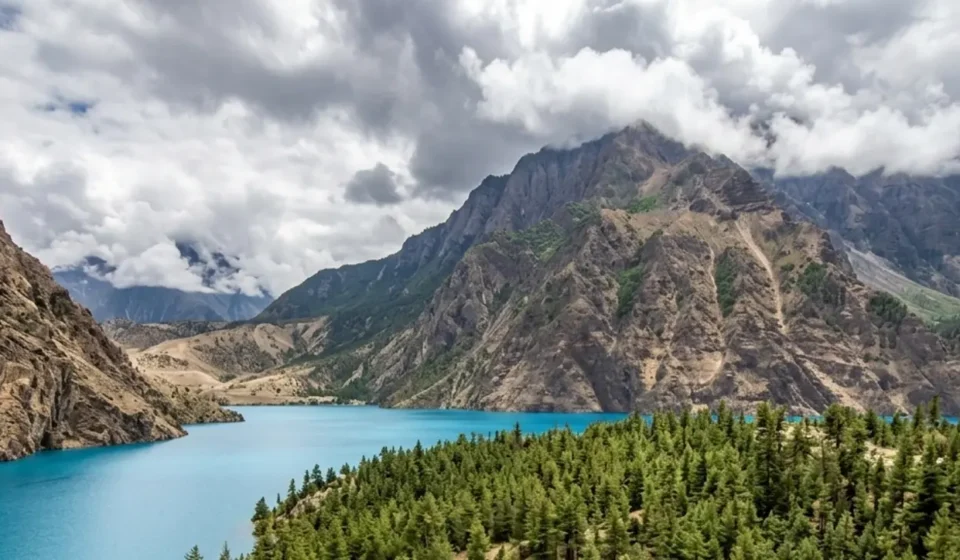
What makes Phoksundo genuinely different from other Himalayan lakes is the color. The water shifts between deep turquoise, cobalt, and emerald depending on the light and season, framed by bare cliffs and the snow-capped Kanjiroba massif. The lake has no aquatic life visible near the surface, which contributes to its almost unnatural clarity. Locals consider it sacred, and religious rules prohibit swimming or polluting the water.
If the landscape looks cinematic, that’s because it is. Éric Valli’s 1999 Oscar-nominated film Himalaya (originally titled Caravan) was filmed in this region, putting Dolpo’s yak caravans and salt-trading culture on the world’s screens.
How Do You Get to Shey Phoksundo Lake?
The standard route requires two flights and roughly three days of walking. You fly from Kathmandu to Nepalgunj in the western Terai (about 50 minutes), stay overnight, then take a short 20-passenger mountain flight from Nepalgunj to Juphal airstrip (2,475 m) in Dolpa. From Juphal, the trek to the lake takes about three days on foot.
The trail follows the Thuli Bheri River to Dunai, the district headquarters, then turns north along the Suligad River. You’ll pass the national park checkpoint at Sulighat, walk through walnut, maple, and cedar forests to Chhepka, and continue past Jharana Waterfall — at roughly 167 meters, one of the highest waterfalls in Nepal, formed by the lake’s outflow. The final approach climbs to Ringmo, a Tibetan-style village of stone and mud houses sitting on the ancient landslide dam that created the lake. From Ringmo, Phoksundo Lake is a short 1.5-kilometer walk.
There is no road access to the lake. A rough overland route via Surkhet and Dunai exists for the adventurous, but virtually all trekkers fly via Nepalgunj and Juphal.
Trekking permit details about Shey Phoksundo Lake trek can be found here.
What Is the Best Shey Phoksundo Lake Trek Itinerary?
Most itineraries run 7 to 11 days from Kathmandu. Here is a balanced 9-day version that allows a full exploration day at the lake:
| Day | Route | Altitude | Duration |
|---|---|---|---|
| 1 | Fly Kathmandu → Nepalgunj | 150 m (Nepalgunj) | 55 min |
| 2 | Fly Nepalgunj → Juphal, trek to Dunai | 2,140 m | 2–3 hrs |
| 3 | Dunai → Chhepka | 2,720 m | 5–6 hrs |
| 4 | Chhepka → Jharana / Amchi Hospital area | 3,110 m | 5–6 hrs |
| 5 | Trek to Ringmo village and Phoksundo Lake | 3,611 m | 4–5 hrs |
| 6 | Exploration day: lake shore, Tshowa Bon monastery, Ringmo | 3,611 m | 3–4 hrs |
| 7 | Ringmo → Chhepka | 2,720 m | 6–7 hrs |
| 8 | Chhepka → Juphal | 2,475 m | 6–7 hrs |
| 9 | Fly Juphal → Nepalgunj → Kathmandu | — | — |
The exploration day on Day 6 is worth protecting. The Tshowa monastery on the lake’s eastern shore is around 900 years old and still holds annual Bon prayer ceremonies, and the viewpoint ridge above Ringmo gives you the classic full-lake panorama that no photograph does justice.
How Difficult Is the Shey Phoksundo Lake Trek?
The Shey Phoksundo Lake trek is rated moderate and is achievable for beginners with reasonable fitness. The maximum altitude of 3,611 meters is well below the danger zone of treks like Everest Base Camp (5,364 m), which significantly reduces altitude sickness risk. There are no technical sections, glacier crossings, or high passes on the standard route.
Expect to walk 5–7 hours per day on well-defined trails with steady ascents and descents, including some exposed sections carved into cliffsides above the Suligad gorge. The real difficulty is logistical, not physical: Dolpo is one of Nepal’s most remote and least developed regions. Teahouses are basic, hot showers and Wi-Fi are rare, food menus are simple, and Juphal flights are weather-dependent — build at least one buffer day into your plans.
If you can comfortably hike for six hours with a daypack, and you’re prepared for simple accommodation, you’re ready for this trek. Training with regular walks, stair climbing, or light cardio for 4–6 weeks beforehand is sufficient preparation for most people.
What Permits Do You Need for the Shey Phoksundo Lake Trek?
You need two permits, and both must be arranged through a registered Nepali trekking agency:
| Permit | Cost | Notes |
|---|---|---|
| Shey Phoksundo National Park entry | NPR 3,000 (~USD 22) | Per person, per entry |
| Lower Dolpo restricted area permit | USD 20 per week, then USD 5/day | Foreign nationals; issued via agency only |
Because Lower Dolpo is a restricted area, independent trekking is not permitted. You must trek with a licensed guide, and the restricted permit formally requires a minimum group of two trekkers (solo trekkers can usually be paired through an agency). Carry your passport — permits are checked at the Sulighat entry post.
How Much Does the Shey Phoksundo Lake Trek Cost?
A full-service package from Kathmandu costs approximately USD 1,400–1,900 per person, depending on group size, itinerary length, and operator. Here’s where the money goes:
- Domestic flights: Kathmandu–Nepalgunj–Juphal return runs roughly USD 350–450 and is the single largest expense
- Permits: Around USD 45–50 total for a week-long trek
- Guide and porter: A licensed English-speaking guide costs USD 25–35/day; a porter (shared between two trekkers) USD 20–25/day
- Food and lodging: Teahouse rooms and three meals a day run USD 30–40 per day in Dolpo — higher than Annapurna or Everest regions because all supplies arrive by mule or plane
Budget extra for tips (expected but not mandatory), bottled or purified water, hot showers, and device charging, which are all paid extras on the trail. For mid-range trekkers comparing options, Phoksundo costs more per day than mainstream routes — that’s the price of remoteness, and the empty trails are what you’re buying.
When Is the Best Time to Trek to Shey Phoksundo Lake?
The best seasons are spring (March to May) and autumn (September to November). Spring brings stable weather, blooming rhododendrons in the lower forests, and clear views of the Kanjiroba range. Autumn offers the most reliable flight conditions, crisp air, and the deepest lake colors.
One advantage Dolpo has over eastern Nepal: it sits partially in the Himalayan rain shadow, so it receives less monsoon rainfall than Everest or Annapurna. Summer treks (June–August) are possible but flights to Juphal become unreliable and trails can be slippery. Winter (December–February) brings heavy snow and closed teahouses at Ringmo — not recommended unless you’re highly experienced.
Who Are the Dolpo People, and What Is the Bon Religion?
The upper Suligad valley and Ringmo village are home to the Dolpo-pa, an ethnically Tibetan people whose lifestyle — yak herding, weaving, and seasonal trade — has changed little in centuries. Ringmo is one of the few places in Nepal where Bon, the spiritual tradition that predates Buddhism in Tibet, remains the dominant faith.
Bon practice looks superficially similar to Tibetan Buddhism but reverses key rituals: practitioners circle stupas and mani walls counterclockwise rather than clockwise. More than 20 stupas dot the lake’s southern shore, and the Tshowa monastery on the eastern bank still conducts annual worship. When visiting, walk around religious monuments in the direction locals do, ask before photographing people, and never touch or remove items from shrines. Phoksundo is a living sacred site, not a backdrop.
Frequently Asked Questions
How deep is Shey Phoksundo Lake? Shey Phoksundo Lake is approximately 145 meters deep, making it the deepest lake in Nepal. It sits at 3,611 meters above sea level in Shey Phoksundo National Park.
Can beginners do the Shey Phoksundo Lake trek? Yes. The trek is moderate, with a maximum altitude of 3,611 m and daily walks of 5–7 hours. Beginners with basic fitness who prepare with regular walking can complete it comfortably.
Do I need a guide for Shey Phoksundo Lake? Yes. Lower Dolpo is a restricted area, so a licensed guide and agency-issued permits are legally required. Independent trekking is not permitted.
Is swimming allowed in Phoksundo Lake? No. The lake is sacred to the local Bon community, and swimming or polluting the water is prohibited by both religious custom and national park rules.
Is there phone signal or Wi-Fi on the trek? Coverage is patchy. NTC SIM cards work in Dunai and intermittently elsewhere; Ringmo has limited connectivity. Treat the trek as largely offline and inform family of your itinerary in advance.
How does Shey Phoksundo compare to Rara Lake? Rara is Nepal’s largest lake; Phoksundo is its deepest. Rara’s trek is slightly easier and greener, while Phoksundo offers more dramatic cliffs, Bon culture, and a wilder, drier landscape.
Is the Shey Phoksundo Lake Trek Worth It?
Absolutely — if you value solitude over convenience. For roughly the same effort as a mainstream teahouse trek, Shey Phoksundo delivers Nepal’s deepest lake, its largest national park, its highest waterfall, and one of the last living Bon communities on earth, all without the crowds. It’s the trek for people who want to feel like they’ve genuinely gone somewhere.
Planning a bigger Nepal trip? Pair this guide with our complete guide to vacationing in Nepal, or compare difficulty levels in our beginner’s trekking guide before you commit.