Teahouse and Homestay Life in Ghandruk: Where a Remote Team Can Work, Hike, and Actually Slow Down
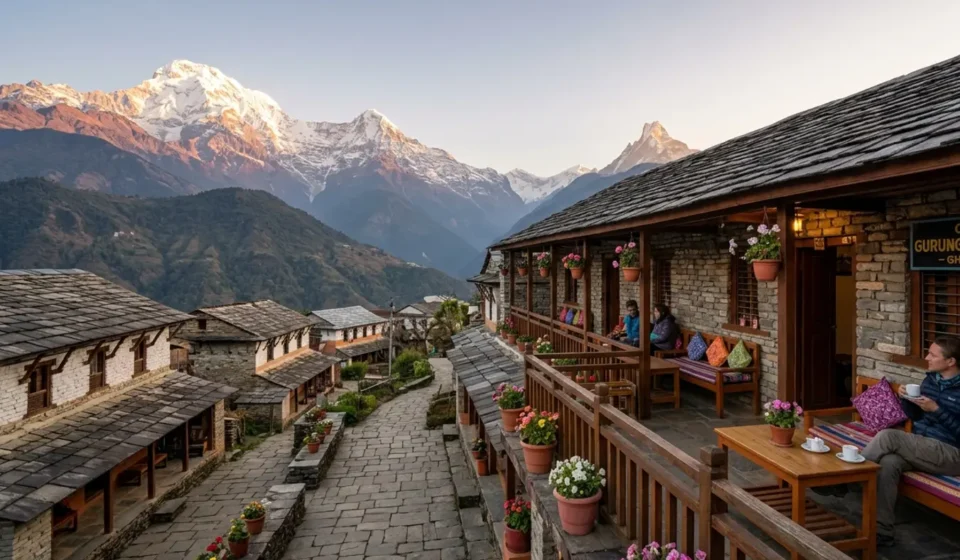
There’s a particular kind of quiet that settles over Ghandruk in the evening — woodsmoke drifting between stone houses, someone’s grandmother sorting millet on a verandah, the Annapurna range turning pink and then grey above the rooftops. It’s the kind of quiet that’s hard to find anywhere near a city of any size. And yet Pokhara, Nepal’s lakeside adventure capital with its airport, cafés, and reliable power grid, is only a few hours away by road.
That combination — genuine, lived-in mountain culture within arm’s reach of a real city — is rare. It’s also exactly what makes Ghandruk one of the few villages in Nepal that can comfortably host a team of remote workers for two weeks, not just a trekker passing through for one night.
This is a guide to what tea house and homestay culture actually looks like in Ghandruk, written for the kind of group that wants to spend their mornings on a call and their afternoons on a trail, and their evenings sitting with the people who actually live there.
What is teahouse and homestay culture in Nepal?
Teahouses are small, family-run lodges built along Nepal’s trekking routes, offering a room, blankets, and home-cooked meals in exchange for a modest nightly rate — historically priced low enough that the real income comes from food, not the bed itself. Homestays go a step further: you’re not renting a room next to a family’s house, you’re staying inside it, eating what they eat, and often joining whatever the household is doing that evening, from husking corn to preparing for a festival. Both systems grew out of necessity and hospitality in roughly equal measure — Himalayan villages have been feeding and sheltering travelers for centuries, long before “trekking” was a word anyone used.
In Ghandruk specifically, that tradition is unusually well developed. The village holds roughly fifty hotels, lodges, and homestays for a settlement of a few thousand people, ranging from simple family rooms to comfortable guesthouses with attached bathrooms and dining halls that double as the social center of the village every evening.
Why Ghandruk, out of every village in the Annapurna region?
Ghandruk earns its place for one reason above all others: it’s organic and unmistakably Gurung, but it never asks you to disconnect from the world to get there. It sits at roughly 1,940–2,012 meters in the Kaski district, well within the Annapurna Conservation Area, with direct views of Annapurna South, Hiunchuli, and the sacred fishtail peak of Machhapuchhre rising directly behind the rooftops.
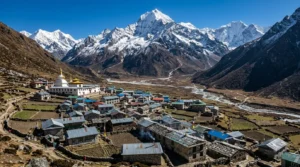
It’s also a living village, not a trekking checkpoint that empties out once the season ends. Houses here are slate-roofed stone and whitewashed lime, arranged around courtyards where locals still gather the way they have for generations. The Gurung Heritage Trail runs through here, and the village’s own cultural museum documents a way of life — the Bon-rooted spirituality, the Tibetan Buddhist influence, the traditional dress and dance — that’s still actively practiced, not preserved behind glass.
For a remote team, that authenticity matters as much as the scenery. You’re not staying in a town built for tourism. You’re staying in a town that happens to welcome tourists.
How do you actually get there from Pokhara?
You can expect roughly a 2.5 to 4-hour journey from Pokhara to Ghandruk, depending on whether you drive the whole way or combine a jeep ride with a short hike. The village sits about 32 kilometers northwest of Pokhara as the crow flies, or 55–60 kilometers by the winding mountain road.
There are two practical routes for a group:
- Drive to Kimche, then walk roughly 30–60 minutes uphill. This is the easiest option for a team carrying laptops, monitors, or extra gear — minimal walking, maximum comfort.
- Drive to Nayapul, then trek 3–5 hours through Birethanti and Syauli Bazaar. This is the classic approach, winding along the Modi Khola river through forest and terraced fields, and it’s worth doing at least once if your group has a free day to spare — perhaps on arrival, before the work schedule kicks in.
For a group of 6–10 people staying two weeks, the Kimche route in is the more sensible choice on day one, with the Nayapul trail saved for a day hike later in the trip when nobody’s hauling a duffel bag full of cables.
What does accommodation look like for a group of 6–10?
This is where Ghandruk genuinely stands apart from smaller villages in the region. Because of its size and long trekking history, Ghandruk has multiple lodges with the room count to handle a group of ten without splitting everyone across three different buildings. Properties like Mountain Lodges of Nepal’s Ghandruk property run to roughly eighteen rooms, and several other guesthouses offer a similar scale — enough for a team to take a whole floor, or even a whole lodge during shoulder season.
Expect twin-share rooms as the default setup: two beds, a thick duvet, a small writing desk in the better lodges, and a window that almost certainly faces the mountains. Hotel-style rooms in Ghandruk run around $20 a night, while a true family homestay averages closer to $5 a night, with the difference being privacy and an attached bathroom versus a deeper, more personal connection with a host family.
For a working group, here’s the honest trade-off:
- Lodges give you reliable power outlets, a dedicated dining hall that doubles as a meeting room, attached bathrooms, and the kind of predictability a two-week remote stint actually needs.
- Homestays give you a more intimate cultural exchange, but with a group of 6–10, you’ll likely need to split across two or three host families, which works beautifully for the evenings but is harder to coordinate for daytime work blocks.
The strategy most groups land on: book a lodge as your daytime base and “office,” then arrange one or two homestay dinners or an overnight swap partway through the trip, so the team gets both the convenience and the deeper immersion.
What’s the food actually like?
Meals in Ghandruk run on the same rhythm as everywhere else in the hills — dal bhat, the lentil-rice-vegetable plate that powers most of rural Nepal, served with unlimited refills in most lodges. Beyond that staple, you’ll find momos, thukpa (Tibetan noodle soup), kodo ko roti (a hearty buckwheat flatbread), and sikarni, a sweetened, cardamom-spiced curd dessert that’s worth ordering at least once. Better-equipped lodges also stretch into Indian, Chinese, and simplified Western dishes — fried rice, noodles, the occasional pizza — though the further you get from the standard menu, the longer (and pricier) the wait.
Because most teahouses earn their living from food rather than room rates, you’re expected to eat where you sleep. For a two-week group stay, this works in your favor: lodge owners get to know your team’s preferences fast, and meals start arriving exactly the way you like them by day three or four.
Can you actually work remotely from here?
Yes — with realistic expectations. Ghandruk has electricity through a local micro-hydro power plant, and most lodges and many homestays offer Wi-Fi alongside reasonable mobile data coverage, which puts it well ahead of villages higher up the trail. That said, this is still rural Nepal: connectivity can dip during bad weather or power fluctuations, and you should plan around it rather than against it.
A few practical notes for a working group:
- Bring a real power strip and adapters. Nepal uses two-pin sockets, and a single lodge outlet won’t cover ten laptops.
- Pack a power bank. Charging is sometimes billed separately in smaller homestays, and outages do happen.
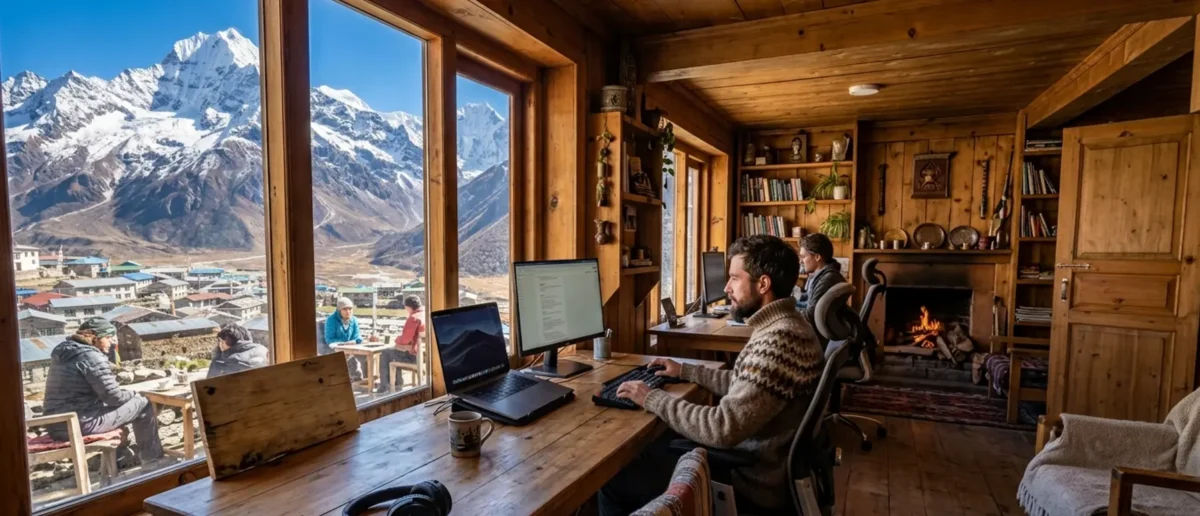
- Treat the dining hall as your office. It’s usually the warmest, best-lit, most central room in any lodge — and conveniently, it’s also where the Wi-Fi router tends to live.
- Schedule your heaviest video-call hours for late morning to mid-afternoon, when solar charging and grid power are both at their most reliable.
- Don’t plan on streaming-quality bandwidth. Email, Slack, docs, and most video calls are realistic. A ten-person team all running simultaneous 4K calls is not.
For a strategy team, a content team, or any group whose work is laptop-and-call based rather than bandwidth-heavy, two weeks in Ghandruk is genuinely workable — not a “roughing it” compromise, but a different kind of office with a much better view.
What does a day actually look like?
The shape of a working day in Ghandruk tends to settle into something like this:
Morning — Coffee or milk tea on the lodge balcony, mountains lit gold by sunrise, then a focused work block before the village fully wakes up. This is the quietest, most productive stretch of the day.
Midday — Lunch, followed by either a continued work block or a short hike. Ghandruk’s surroundings are made for exactly this: gentle trails to nearby viewpoints, the short walk to Kimrong Danda, or a wander down toward the river, all manageable in two to three hours without derailing the day’s schedule.
Afternoon — A second work block for calls that need overlap with other time zones, often the busiest stretch if your team is coordinating with people back home.
Evening — This is where Ghandruk earns its reputation. Dinner in the dining hall, often followed by villagers gathering for conversation, sometimes a folk performance — Gurung women in red velvet and heavy silver jewelry, dancing to a drumbeat that carries across the courtyard. Some lodges arrange this for groups on request; in smaller homestays, it happens organically, because that’s simply what the evening is for.
For a team that’s been staring at screens all day, that’s not a tourist add-on. It’s the actual reset.
A sample two-week rhythm
A loose two-week structure that balances work, hiking, and culture without overloading any single day:
- Days 1–2: Travel from Pokhara to Ghandruk (via Kimche), settle in, light orientation walk around the village, first evening with the host community.
- Days 3–7: Core work week. Morning and afternoon work blocks, short afternoon hikes to nearby viewpoints, evenings free for conversation, cards, or a cultural evening.
- Day 8: Full rest and trek day — the longer hike to Kimrong Danda or a loop toward Tadapani, no work scheduled.
- Days 9–12: Second work week, with one homestay night arranged with a local family for a deeper exchange.
- Day 13: Visit to the Gurung Heritage Museum, a slower day, final village walks, farewell dinner.
- Day 14: Return trek or drive to Pokhara.
This rhythm gives the team roughly nine to ten genuine working days — enough for a real two-week sprint — while still leaving room for the hiking and village time that make the destination worth choosing in the first place.
What about permits and logistics for a group this size?
Every visitor to Ghandruk needs two documents: an Annapurna Conservation Area Permit (ACAP) and a TIMS (Trekkers’ Information Management System) card, both obtainable in Kathmandu or Pokhara before you head up. For a group of 6–10, it’s worth processing these together in one batch and assigning one person to carry the full set — checkpoints along the route will ask for them.
It’s also worth booking lodge rooms ahead of time for a stay this long, particularly if you want a single property to hold your whole group during peak seasons (spring and autumn). A two-week booking is unusual enough that most lodge owners will be glad to confirm it directly rather than risk a last-minute scramble.
Frequently asked questions
Is Ghandruk too touristy to feel authentic?
It’s one of the more visited villages in the Annapurna region, but it hasn’t been hollowed out by that. The Conservation Area’s regulations limit unchecked development, and the village remains agricultural and Gurung-led at its core — tourism sits alongside daily life here rather than replacing it.
Do we need a guide for a two-week stay?
Not strictly, since Ghandruk itself is easy to reach and navigate. A local guide is still worth hiring for the surrounding day hikes and for smoothing communication with host families, especially for a group this size.
What’s the best season for a long stay?
Spring (March–May) brings rhododendron blooms and mild trekking weather; autumn (late September–November) brings the clearest mountain views. Both are peak season, so book lodge space early. Winter is quieter and colder but still workable for a team that doesn’t mind extra layers.
Will the whole team be able to stay together?
Generally yes, at one of the larger lodges. Confirm room blocks in advance rather than assuming availability on arrival, particularly in peak months.
There’s a version of “remote work retreat” that means a co-working space with a nice view. Ghandruk is the other version — the one where your team’s evenings are spent watching a Gurung drumbeat carry across a stone courtyard, and your mornings start with Annapurna South lit up outside the window, and somewhere in between, the actual work still gets done.