Sherpa People: History, Culture, and the Backbone of Everest (2026)
When most people hear the word “Sherpa,” they picture a high-altitude guide carrying a loaded pack on the slopes of Everest. That image is real, but it is only the surface of a 600-year-old civilization.
The Sherpa people are a Tibetan ethnic group who migrated to Nepal’s Khumbu valley centuries before mountaineering existed. They built monasteries at 3,800 meters, raised yaks on glacial pastures, traded salt and wool across Himalayan passes, and developed a culture so deeply tied to the mountains that they gave Everest its most enduring name: Chomolungma — Mother Goddess of the World.
Understanding who the Sherpas are transforms the EBC trek from a physical achievement into a cultural encounter. This guide covers their origins, their biology, their faith, their festivals, and their irreplaceable role in Himalayan mountaineering.
Sherpa People at a Glance
| Detail | Information |
|---|---|
| Ethnic origin | Tibetan (Kham region, eastern Tibet) |
| Migration period | 13th to 16th centuries |
| Primary homeland | Solukhumbu District, eastern Nepal |
| Population in Nepal | ~150,000 to 250,000 |
| Language | Sherpa (Tibeto-Burman family) |
| Religion | Nyingmapa sect of Vajrayana Buddhism |
| Cultural heartland | Khumbu valley (Namche Bazaar, Tengboche, Pangboche) |
| Most sacred peak | Chomolungma (Mount Everest) |
| Most important festival | Mani Rimdu (November, Tengboche Monastery) |
| Record Everest summits | Kami Rita Sherpa — 29 summits as of 2026 |
Who Are the Sherpa People? The Origin Story
The word “Sherpa” comes from the Tibetan “Shar-pa” — meaning “people from the east.” It is a direct reference to their origins in the Kham region of eastern Tibet, from which they began migrating southward during the 13th and 14th centuries.
Oral Sherpa history lists four clans who migrated from Kham to Solukhumbu: Minyakpa, Thimmi, Lamas Sherwa, and Chawa. These clans eventually evolved into more than 20 distinct groups.
They chose high-altitude valleys between 3,000 and 5,000 meters — elevations where most other communities could not establish permanent settlements. The Khumbu and Solu regions of what is now Nepal’s Solukhumbu District became their homeland, with the dramatic peaks of the Mahalangur Himal range forming the northern boundary of their world.
For centuries after settling, the Sherpas were not mountaineers. They were traders, farmers, and herders moving salt, wool, and rice along high passes between Nepal and Tibet, cultivating barley and buckwheat in the thin soils of the Khumbu valleys, raising yaks on the high pastures above the tree line.
The mountains surrounding them — including the one the world would eventually call Everest — were not routes or objectives. They were sacred deities deserving reverence, not conquest.
The Sherpa Genetic Advantage: Why They Thrive at Altitude
One of the most remarkable facts about the Sherpa people is biological. Their generations of living above 3,000 meters have produced physiological adaptations that science is still working to fully understand.
Research has established that Sherpas process oxygen at altitude more efficiently than lowland populations. It has been speculated that part of the Sherpas’ climbing ability is the result of a genetic adaptation to living in high altitudes, which may include unique hemoglobin-binding capacity and doubled nitric oxide production.
Studies have found that Sherpas’ genetic traits are similar to those of Tibetans, which is likely as they are descendants of people from Tibet’s eastern province of Kham. This genetic trait enables them to survive in the Himalayas’ high altitudes without much hassle.
In practice, this means a Sherpa guide ascending to Everest Base Camp carries loads and moves at paces that would cause severe altitude sickness in most international climbers doing the same route. It is not simply fitness — it is centuries of adaptation playing out in real time on every expedition.
For trekkers on the EBC trail, this explains something you notice quickly: your guide is not gasping at the same points you are.
Where Sherpas Live: The Khumbu Valley and Beyond
Most Sherpas are settled in the Solukhumbu District of Nepal, especially around the Khumbu area, which includes Namche Bazaar, Khumjung, Kunde, Thame, and Pangboche. There are also Sherpa settlements in Rolwaling, Helambu, and around the Langtang area, as well as Sherpas who have settled around Kathmandu.
The Khumbu valley — the region through which the entire EBC trek passes — is the cultural and spiritual heartland of the Sherpa people. Every village along the trail from Lukla to Gorak Shep is a Sherpa settlement, and the architecture, prayer flags, mani walls, and chortens you walk through are not decorative. They are a living religious landscape.
Namche Bazaar at 3,440 meters is the commercial and administrative hub of the Khumbu — a horseshoe-shaped market town that has been a trading crossroads between Nepal and Tibet for centuries. The Saturday market in Namche brings Sherpa families from across the valley, and the town’s bakeries, gear shops, and teahouses reflect both the traditional culture and its modern evolution through tourism.
Tengboche at 3,867 meters is the spiritual center. The establishment of the monastery at Tengboche in 1916 became a significant spiritual landmark in Sherpa culture, and it continues to be central to their religious practices. Tengboche Monastery stands at 3,867 metres with Everest and Ama Dablam visible from its courtyard — it is not merely a religious site but the cultural heart of the Khumbu.
Pangboche is the highest permanently inhabited Sherpa village on the EBC route and home to a monastery believed to be the oldest in the Khumbu region.
Sherpa Religion: Mountains as Sacred Beings
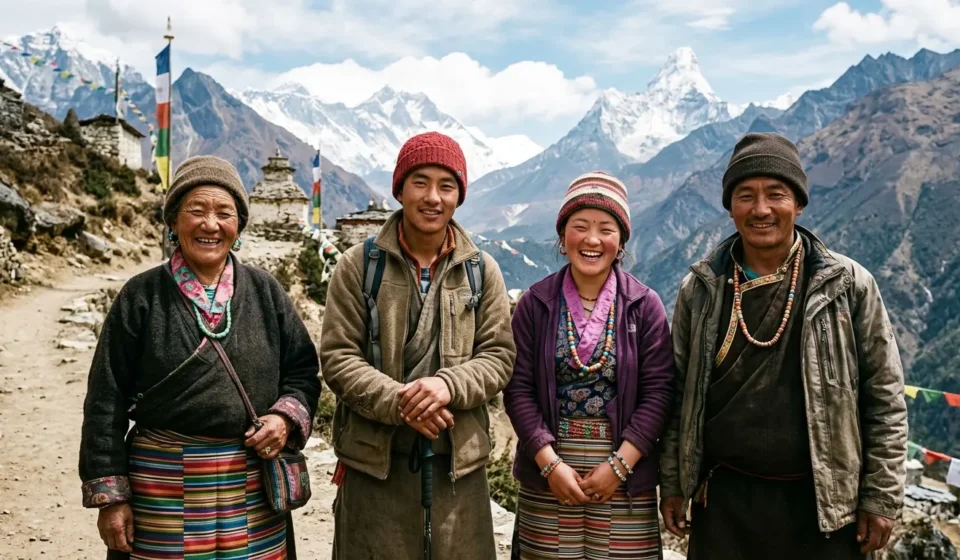
Sherpa culture and religion are inseparable. Sherpa culture and history cannot be understood without understanding Tibetan Buddhism. The Sherpa community follows the Nyingmapa sect of Vajrayana Buddhism, the oldest school of Tibetan Buddhism, introduced to the region by the Indian saint Guru Rinpoche (Padmasambhava). For Sherpas, mountains are not merely landforms — they are sentient beings.
Mount Everest is known as Chomolungma, the “Mother Goddess of the World.” Lhotse, Makalu, and Cho Oyu are similarly regarded as protector deities of the region.
This is not metaphor. Before every mountaineering expedition departing from Everest Base Camp, a puja ceremony is performed — a Buddhist blessing ritual that seeks permission from the mountain deity to climb. No reputable Sherpa guide begins an expedition without it, and most international climbing teams follow the same practice regardless of their own religious background. It is both a spiritual obligation and, in the high-stakes environment of Himalayan mountaineering, a grounding ritual that focuses the entire team before they enter the Khumbu Icefall.
The religious landscape you walk through on the EBC trek is intentional and dense. Mani walls — long stone walls carved with the sacred mantra “Om Mani Padme Hum” — line trail junctions throughout the Khumbu. The tradition is to walk to the left of a mani wall, keeping it on your right side. Prayer flags stretched between peaks and teahouses carry mantras that, according to Buddhist belief, are released into the wind with every movement of the flag. Chortens (stupas) mark important spiritual locations throughout the valley.
Sherpa Festivals: The Cultural Calendar of the Khumbu
Mani Rimdu — The Most Important Sherpa Festival
Mani Rimdu is the most internationally recognized Sherpa festival. The full ceremony lasts 19 days, concluding with three days of public celebration at Tengboche Monastery at 3,867 metres. Monks perform sacred masked Chham dances alongside fire offerings, and the abbot distributes blessed pills to the assembled community.
The 2026 public festivities run from 24 to 26 October. Trekkers on the Everest Base Camp Trek during this period have the opportunity to witness one of the finest cultural events in the entire Himalayas.
If you are planning your EBC trek in October and have any flexibility in timing, arrange your Tengboche arrival to coincide with Mani Rimdu. The masked dances performed by the monks represent Buddhist cosmology — the defeat of evil forces, the protection of the Dharma — and the gathering of Sherpa families from across the Khumbu turns the monastery grounds into a genuine community celebration that feels nothing like a tourist performance.
Losar — Sherpa New Year
Losar is the Tibetan New Year, celebrated in February or March depending on the lunar calendar. The Losar festival is a religious festival celebrated in winter. It is a time for celebration and feasting and is considered the most important festival in the Sherpa calendar. Families clean their homes, make offerings at local monasteries, and come together for communal meals. Villages that feel quiet during the trekking off-season come fully alive during Losar.
Dumje
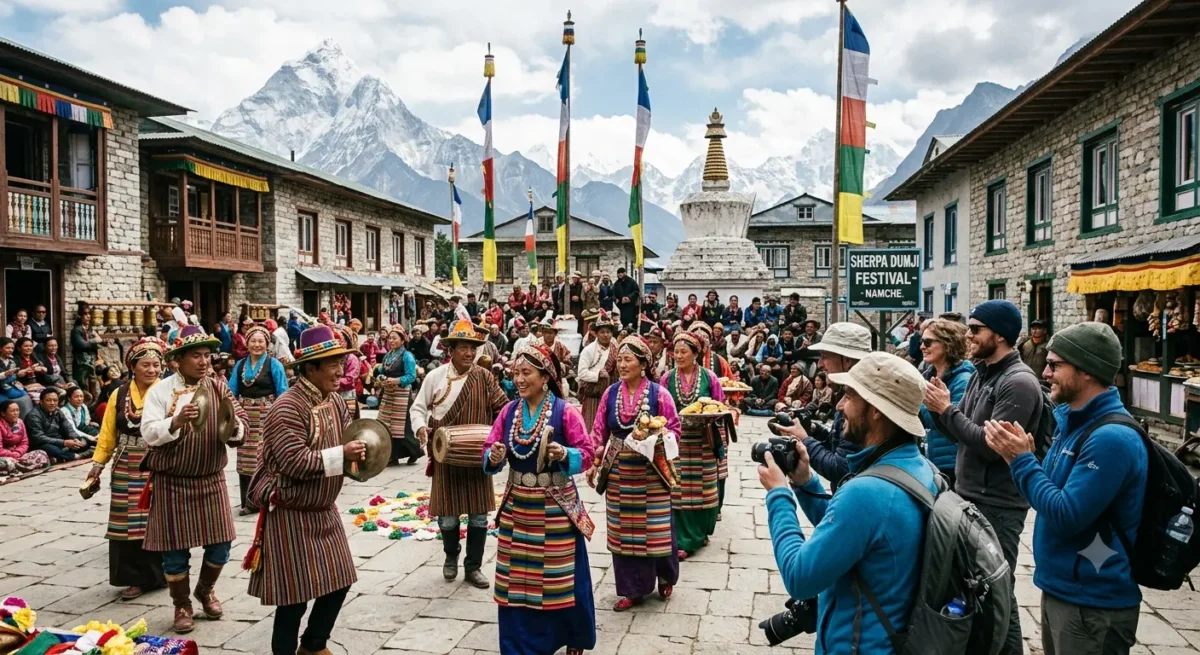
Dumje is a summer festival celebrated specifically in the Khumbu villages to honor the mountain deities and pray for community prosperity. Monks perform week-long ceremonies at local gompas, and the festival involves communal dancing, feasting, and the display of sacred thangka paintings. Dumje is rarely witnessed by foreign trekkers since it falls during monsoon season — which makes it one of the most authentically local Sherpa cultural events accessible to visitors with off-season schedules.
Sherpa Architecture and Daily Life
Traditional Sherpa homes are built from stone with flat roofs and small windows designed to conserve heat at altitude. The ground floor typically houses livestock during winter, while the upper levels contain the family living space and a dedicated prayer room with butter lamps and thangka paintings.
The interior design of a traditional Sherpa home reflects the merger of practical mountain living with Buddhist spirituality. The prayer room — present in virtually every Sherpa household — contains a butter lamp burning continuously before a shrine, thangka paintings depicting Buddhist deities, and offerings of rice, water, and incense. Elders of the family maintain this room as a daily practice, not a ceremonial gesture.
Sherpa food evolved for the specific demands of high-altitude life. Thukpa is a noodle soup with flavorful broth filled with vegetables and spices, whereas Thenduk is more of a stew with chunks of meat, potatoes, and dough cooked to perfection. Aloo Roti, or potato pancakes, is another known delicacy — like a flatbread made with potatoes, flour, and eggs served with spicy sauce.
The potato was introduced to the Sherpa in the 19th century. Since potatoes grow well in high elevations, they became the staple of the Sherpa diet. Today, potatoes remain central to Sherpa cuisine — you will find them in various forms at every teahouse on the EBC trail.
Yaks remain an essential part of Sherpa economic and cultural life. They provide milk for butter tea and cheese, carry loads along high-altitude sections of the trail where horses cannot go, and are central to pastoral traditions that have persisted for centuries. The yaks you encounter on the trail between Namche and Gorak Shep are working animals — always give them right of way on the uphill side of the trail.
Sherpas and Mountaineering: From Traders to Legend
Nepal opened its borders to foreigners in 1950. Within three years, Sherpas had become the essential partners of every serious Himalayan expedition.
When Tenzing Norgay climbed Mount Everest with Edmund Hillary in 1953, the Sherpas of the Himalayas finally gained recognition worldwide. However, the Sherpas had been the backbone of mountaineering in the Himalayas for many years — not as porters but as exceptional mountaineers, guides, and natives of a culture shaped by life on the roof of the world.
Tenzing Norgay’s achievement on May 29, 1953, was not a discovery of Sherpa capability — it was its global announcement. Sherpa guides had been navigating the Khumbu Icefall, fixing ropes on the Lhotse Face, and establishing high camps for international expeditions since the earliest Everest attempts in the 1920s.
The record that most powerfully illustrates the Sherpa relationship with Everest belongs to Kami Rita Sherpa. Kami Rita Sherpa currently holds the record with 29 summits as of 2026. These achievements reflect a generational relationship with the mountains that is inseparable from Sherpa cultural identity.
Other legendary Sherpa mountaineers include:
Pasang Lhamu Sherpa — the first Nepali woman to summit Mount Everest in 1993, breaking significant barriers in a male-dominated field. Her achievement empowered many Sherpa women to pursue their dreams in mountaineering and beyond.
Apa Sherpa — 21 successful Everest summits, earning the nickname “Super Sherpa” and dedicating years to environmental advocacy for the Himalayas.
Nima Rinji Sherpa — became the youngest person to climb all fourteen peaks above 8,000 meters, a feat that added a new generation to the Sherpa mountaineering legacy.
The Work Behind the Summit
Public attention focuses on summit records. The daily reality of Sherpa work on Everest is far more demanding than summit tallies suggest.
It is not uncommon for Sherpas to go through the Khumbu Icefall about 30 times each season, while individual foreign clients only go through two or three times per season. Sherpas are expected to haul most of their clients’ gear to each of the five camps and set them up before their clients arrive.
The Khumbu Icefall — the most dangerous section of the standard Everest route — is traversed repeatedly by Sherpa teams fixing ropes, carrying loads, and establishing the route before any client sets foot on it. The risk is disproportionate and historically acknowledged. The 2014 Khumbu Icefall avalanche that killed 16 Sherpa guides in a single day prompted the first organized labor action in Himalayan mountaineering history, and it focused international attention on the disparity between risk borne and compensation received.
The Language of Misuse: “Sherpa” Is Not a Job Title
Many apply the “sherpa” label to any high-altitude porter or guide in error. When “sherpa” becomes generic for any climbing assistant, it erases Sherpa ethnic identity and further enables cultural appropriation. It conceals that non-Sherpa Nepalis — Tamangs, Rais, Magars, and Gurungs — also work in mountain tourism and deserve recognition for their particular ethnic identities.
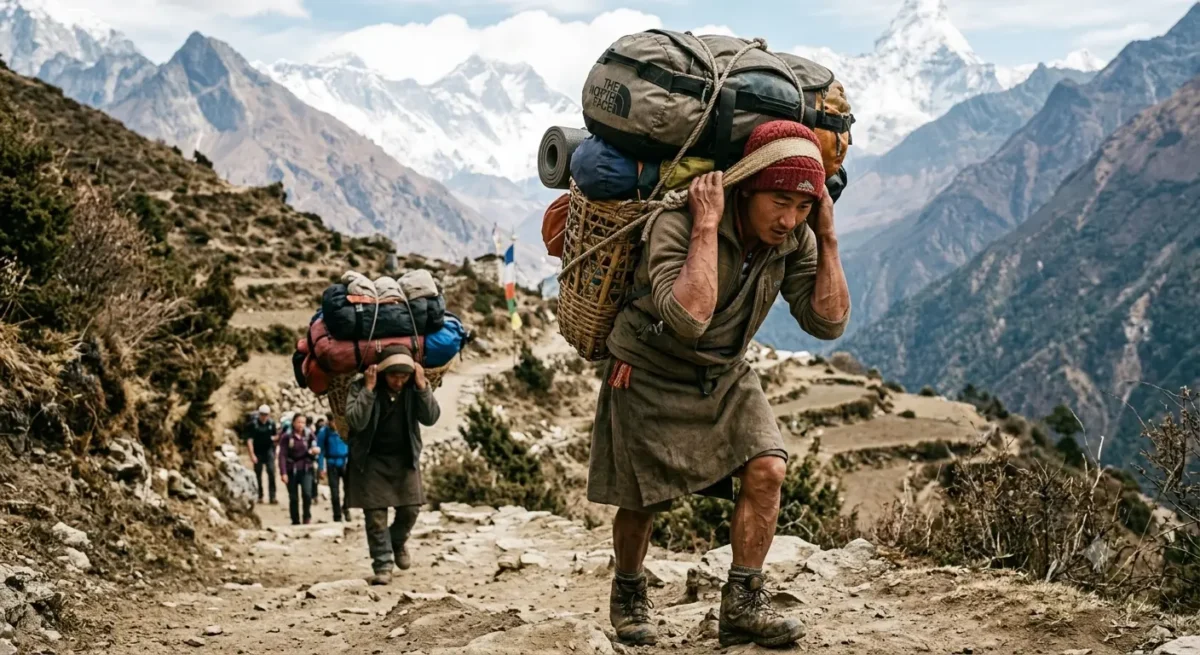
The correct terminology matters both for accuracy and respect. An ethnic Sherpa working as a climbing guide is a Sherpa guide. A non-Sherpa Nepali working as a mountain guide is a high-altitude guide or mountain guide. A load carrier of any ethnicity is a porter or support staff.
When you book your EBC trek, ask your agency whether your guide is an ethnic Sherpa or a guide from another community. Both are qualified professionals — but calling all of them “Sherpas” erases the distinction between different communities contributing to Nepal’s mountain tourism industry.
How Sherpas Have Changed — and What Has Stayed the Same
Tourism has transformed the economic reality of Khumbu Sherpa communities faster than perhaps anywhere else in the Himalayas.
Today, Sherpas’ livelihoods increasingly depend on foreign climbers and trekkers, dramatically changing their way of life. Despite embracing mountaineering, they maintain respect for the mountains, advocating for responsible practices.
Namche Bazaar, once a modest trading post, is now a small mountain town with espresso bars, bakeries serving apple pie and cinnamon rolls, gear shops stocked with North Face and Mammut, and satellite internet in the teahouses. Young Sherpas increasingly receive formal education in Kathmandu and abroad, and Sherpa communities in Kathmandu, New York, and Darjeeling maintain cultural ties across geographic distance.
What has not changed is the core of Sherpa identity: the relationship with the mountains as sacred presences, the Nyingmapa Buddhist practice that structures daily life, the festivals that bring the entire Khumbu community together, and the generational pride in a way of life built at altitudes where most of the world cannot survive without supplemental oxygen.
What Trekkers Get Wrong About Sherpa Culture
“Sherpas are used to the altitude — it’s easy for them.” Altitude physiology gives Sherpas a genuine advantage above 3,000 meters. It does not make high-altitude climbing safe or effortless. Sherpa guides have died on Everest in far greater numbers than the foreign clients they guide. The work is dangerous, the conditions are brutal, and the physical demands are extreme regardless of genetic advantage.
“The guide carries my bag.” Your porter carries your bag. Your guide navigates the route, monitors your health, communicates with teahouses, and makes safety decisions. Conflating the two roles misunderstands the professional structure of the trekking industry and, again, erases distinct contributions.
“Sherpa culture is untouched.” Sherpa culture is living and evolving, not frozen in a pre-tourist era for visitor consumption. Young Sherpas are engineers, doctors, entrepreneurs, and international athletes. The cultural depth you encounter on the EBC trail is genuine — but it exists alongside modernity, not in opposition to it.
“Tips are optional.” In the context of the Khumbu trekking economy, tips to your guide and porter represent a meaningful share of their seasonal income and are an expected part of the transaction. The industry standard for 2026: $15 to $20 per day for guides, $10 to $15 per day for porters, presented in cash at the end of the trek.
Frequently Asked Questions
Who are the Sherpa people? The Sherpa people are a Tibetan ethnic group native to the mountainous regions of Nepal, primarily the Solu-Khumbu District in eastern Nepal. They migrated from the Kham region of eastern Tibet during the 13th to 16th centuries and have developed a distinct culture, language, and physiology shaped by centuries of life at high altitude. Today, approximately 150,000 to 250,000 Sherpas live in Nepal, with their cultural heartland in the Khumbu valley near Mount Everest.
What does the word “Sherpa” mean? The word Sherpa comes from the Tibetan “Shar-pa,” meaning “people from the east.” It is a reference to the Sherpa people’s origins in the Kham region of eastern Tibet. It is an ethnic identity, not a job title — the common use of “sherpa” to describe any mountain guide or climbing assistant is inaccurate and erases the distinct identity of the Sherpa ethnic group.
Why are Sherpas so good at high altitude? Sherpas have developed physiological adaptations through centuries of living above 3,000 meters. Research suggests their bodies process oxygen more efficiently at altitude, with adaptations including unique hemoglobin-binding capacity and increased nitric oxide production. These are genetic traits refined over generations of high-altitude habitation, not simply the result of training or acclimatization.
What religion do Sherpas follow? Sherpas follow the Nyingmapa sect of Vajrayana Buddhism — the oldest school of Tibetan Buddhism, introduced to the Khumbu region by the Indian saint Guru Rinpoche. For Sherpas, the mountains are sacred beings rather than geographical features. Mount Everest is revered as Chomolungma, the Mother Goddess of the World. The puja ceremony performed before every Everest expedition reflects this deeply held spiritual relationship with the mountains.
Who holds the record for the most Everest summits? Kami Rita Sherpa holds the record for the most Everest summits with 29 ascents as of 2026. Apa Sherpa and Phurba Tashi each summited 21 times. Tenzing Norgay Sherpa made the first confirmed successful summit of Everest on May 29, 1953, alongside Sir Edmund Hillary.
What is the Mani Rimdu festival? Mani Rimdu is the most important Sherpa festival, held at Tengboche Monastery in the Khumbu valley. The full ceremony lasts 19 days, concluding with three days of public celebration featuring sacred masked Chham dances performed by monks, fire offerings, and the distribution of blessed pills by the monastery’s abbot. In 2026, the public festivities run from October 24 to 26. EBC trekkers in the Khumbu during this period can witness one of the most significant cultural events in the Himalayas.
How many Sherpas live in Nepal? Estimates range from 150,000 to 250,000 Sherpas in Nepal. The 2023 Nepal census recorded 250,637 Sherpas, representing approximately 1.1% of the country’s total population. The largest concentration remains in the Solu-Khumbu district, though significant Sherpa communities also exist in Kathmandu, Darjeeling (India), and internationally — with approximately 11,000 Sherpas reportedly living in New York City alone.
The Bottom Line: Walk Through Khumbu With Open Eyes
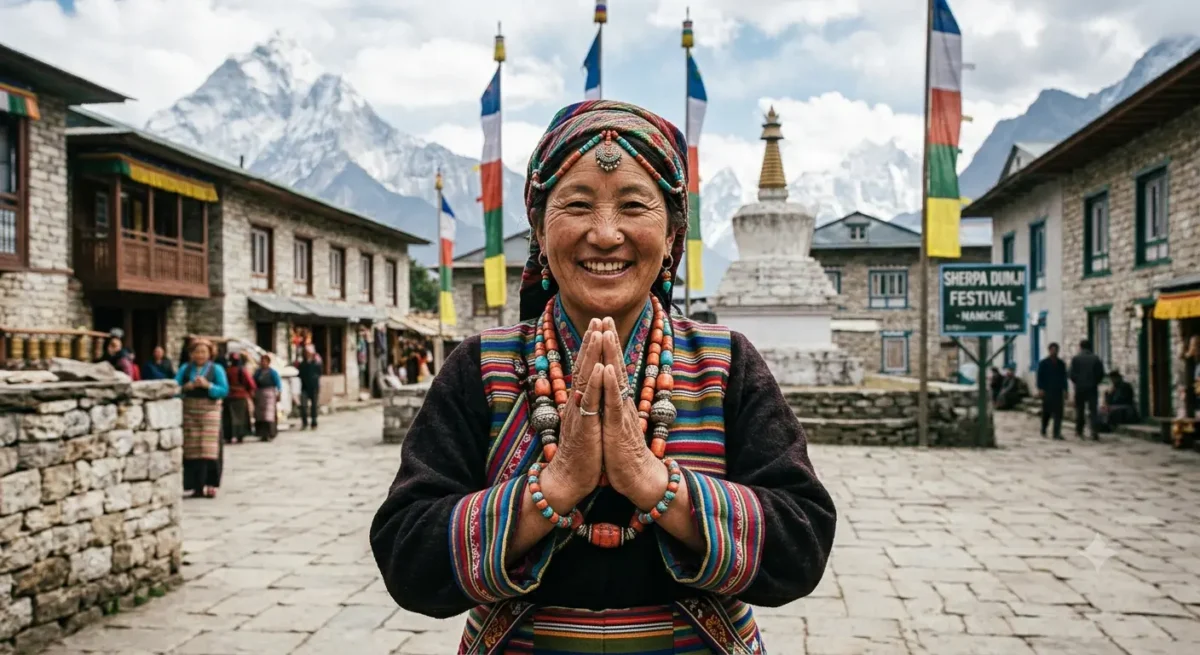
Every trekker who completes the EBC trek walks through the Sherpa homeland. The trail you follow, the teahouses where you sleep, the prayers flags above the suspension bridges, the chants drifting from Tengboche Monastery at dusk — all of it is the living culture of a community that has occupied this landscape for six centuries.
Understanding who the Sherpas are — their origins, their faith, their festivals, their biology, and their role in Himalayan mountaineering — does not add complexity to your trek. It adds dimension. The mountains become more than scenery. The guide walking ahead of you carries more than a route plan. The monastery at Tengboche is more than a photo opportunity.
When trekkers walk through Namche Bazaar, pass mani walls carved with sacred mantras, or sit in a teahouse listening to their guide explain why Mount Everest is considered a goddess, they are encountering a culture that has shaped this landscape for over five centuries.
That encounter is the real reason to trek to Everest Base Camp.